TIG Welder With Pulse Manufacturer: OEM Buying Guide
Introduction
Selecting a TIG welder with pulse manufacturer is not just a search for a pulse button or a high maximum-current figure. An industrial buyer needs a machine that delivers the agreed pulse behavior, fits the material and production cycle, and remains consistent when a sample order becomes a fleet. The questions are practical: which current levels can be set, how are they verified, what happens during a long shift, and what evidence accompanies every shipment?
This guide helps distributors, fabrication plants and OEM purchasing teams turn those questions into a specification and factory acceptance plan. It distinguishes process settings from marketing labels, compares AC/DC and DC pulse configurations, and explains how to request a GWELD quotation that engineering, purchasing and service teams can evaluate together.
What a Pulse TIG Welder Actually Controls

Separate peak, background and timing
Pulse TIG alternates welding current between a peak level and a lower background level. Peak current, background current, pulse frequency and the portion of each cycle spent at peak are different settings. Miller's pulse-settings explanation illustrates these concepts; it describes Miller equipment, not a GWELD specification. Ask the proposed manufacturer which settings are independently adjustable and which are fixed by a program. A low-frequency rhythm may help an operator coordinate filler addition, while a faster pulse can change arc feel and bead behavior. Neither setting guarantees better weld quality. Material, joint design, travel speed, shielding, filler and qualified procedure still determine the result. An OEM pulse TIG welder should be assessed on representative parts against written acceptance criteria, not a demonstration coupon chosen only by the supplier.Check the displayed value against the output
A digital screen may show programmed values without proving that the output follows them under load. Request the test method, instrument type and measurement conditions used at the factory. For important programs, compare saved settings after a power cycle and review whether the operator can accidentally alter a locked procedure. Treat the control interface, actual output and weld result as three related but separate checks.Choose AC/DC Pulse or DC Pulse for the Application
Start with the base metal and qualified process
A DC pulse TIG welding machine can be a suitable starting point for many steel and stainless applications, subject to the approved procedure. Aluminum production commonly requires an AC-capable TIG configuration for oxide cleaning and the application-specific balance of penetration and cleaning. If the order includes both material families, specify the exact AC and DC modes required rather than assuming that every pulse model is interchangeable. GWELD lists both AC/DC pulse and DC pulse product families. The published TIG 315/350P ACDC 和 TIG 300/400/500 直流脉冲 provide starting points for a model-specific discussion. Confirm the current datasheet, input supply, options and actual supplied package with GWELD before ordering. Our AC TIG welder buying guide covers aluminum-specific process selection in more detail.Do not confuse AC waveform controls with pulse controls
An AC machine may expose balance and AC frequency as well as pulse frequency. These are not the same variable. Ask the supplier to show the control menu and parameter sheet for the exact model and firmware revision. Record which combinations are allowed, how memory recalls them, and whether a remote control or foot pedal changes the programmed peak. That prevents a purchasing schedule from promising a setting that the selected machine does not offer in the intended mode.Write a Comparable Pulse TIG Technical Specification
Use one schedule for every bidder
A comparison is useful only when each pulse TIG welder manufacturer answers the same requirement. Describe the materials, thickness range, joint geometries, target production rate, operating environment and required welding modes. Separate a mandatory requirement from a preferred option. State whether the quotation covers only the power source or also the torch, cooler, regulator, cables, remote control and initial consumables.| Specification field | Ask the manufacturer to state | Evidence to retain |
|---|---|---|
| Pulse control | Adjustable peak, background, frequency and peak-time ranges for the selected mode | Current model manual and demonstration record |
| Welding output | Rated current, voltage and duty conditions for the planned shift | Model-specific rating document |
| Process modes | DC, AC, pulse and start modes actually supplied | Configuration sheet and serial-number record |
| Interfaces | Torch, remote, cooler and automation connections | Connection drawing and accessory list |
| Service scope | Warranty terms, parts route and response process | Written commercial and service schedule |
Define the receiving configuration
Record voltage and plug arrangement, language and labeling, cooling choice, torch length, packaging, spare parts and documentation. If the target is a distributor fleet, identify which options must be common across every unit. If the target is one production cell, identify site-specific items. Make a substitution approval rule: a change in board, interface or accessory after sample acceptance requires documented review, even when the marketing model name remains unchanged.Validate Pulse Performance on Representative Welds
Compare an application window, not one beautiful bead
The strongest proof is a controlled trial on representative base metal, thickness, fit-up and welding position. Ask the process engineer to provide the starting WPS or trial plan, filler, shielding gas, preparation and inspection criteria. Trial both a normal joint and a difficult one within the approved envelope. Hold operator technique as constant as practical when comparing equipment, and record every change to the settings. Pulse may reduce average current in a particular setup, but it does not automatically reduce total heat input or eliminate distortion. Travel speed, arc length, peak time and joint conditions matter. Miller's TIG pulse manual shows how peak time relates to the cycle; use the proposed machine's own manual and an approved procedure for actual settings. A qualified welding engineer should approve weld quality, not a marketing statement.Record repeatability through a shift
For production, test start behavior, stable pulse operation, crater fill and restart after thermal cycling. Document arc-on time, pauses and ambient conditions. Compare samples from the beginning and later part of a representative duty pattern. If a system is used with a wire feeder, verify synchronization and cable routing on the actual cell. The pulse feature has procurement value when it helps the approved procedure repeat reliably, not when it merely increases the number of menu choices.Audit the Manufacturer's Batch and Change Controls
Ask how the accepted sample becomes production units
A sample can pass while later units drift if critical components, firmware or calibration practices change without notice. Ask for the production traveler, inspection checkpoints and serial-number traceability applicable to the quoted line. Identify which components are controlled by specification and how substitutes are approved. This is especially important for private-label programs that may have more than one enclosure or user-interface version. The factory should explain the checks performed on every unit and the deeper sample tests performed by batch. Request examples of records with confidential details removed if needed. Where a purchasing contract requires a witness test, write the witness points and notice period into the order. Do not assume that a certificate logo proves waveform performance or that one factory photograph proves the configuration in the shipment.Preserve settings and firmware identity
Record software or firmware revision if it affects control behavior. Ask how stored jobs are backed up, transferred and restored after service. When the fleet contains several models, keep a matrix that maps approved procedures to eligible machines. A change-control notice should explain whether an update affects saved pulse programs, remote-control scaling or accessory compatibility. This keeps the service organization from treating two visually similar machines as technically identical without evidence.Confirm Duty Cycle, Cooling and Interfaces
Use the rating under its stated conditions
Output rating and duty cycle need their test conditions. Ask for the ambient temperature, test period and current at the rating used in the quotation. A headline maximum current may describe a brief operating point rather than the long arc-on pattern of your plant. Match the power source, torch and any cooler to the same production schedule; the limiting part of the package governs practical use. For an integrated station, inspect ventilation clearance, cable and hose lengths, torch rating, remote control and cooling accessories. Our water-cooled TIG package guide explains how to compare the torch, cooler and connections as one system. Pulse settings do not remove those mechanical and thermal constraints.Test external control as a system
Specify foot pedal, hand control, robot or fixture signals by function and connector, not by a vague “automation ready” claim. Test start/stop behavior, parameter selection, alarm feedback and safe response to a disconnected remote using the supplier's approved method. If digital communication is required, ask for protocol documents, supported commands, version and integration responsibility. A factory acceptance report should distinguish functions tested on the bench from those verified after installation.Design a Factory Acceptance Test for Pulse TIG
Agree on evidence before the purchase order
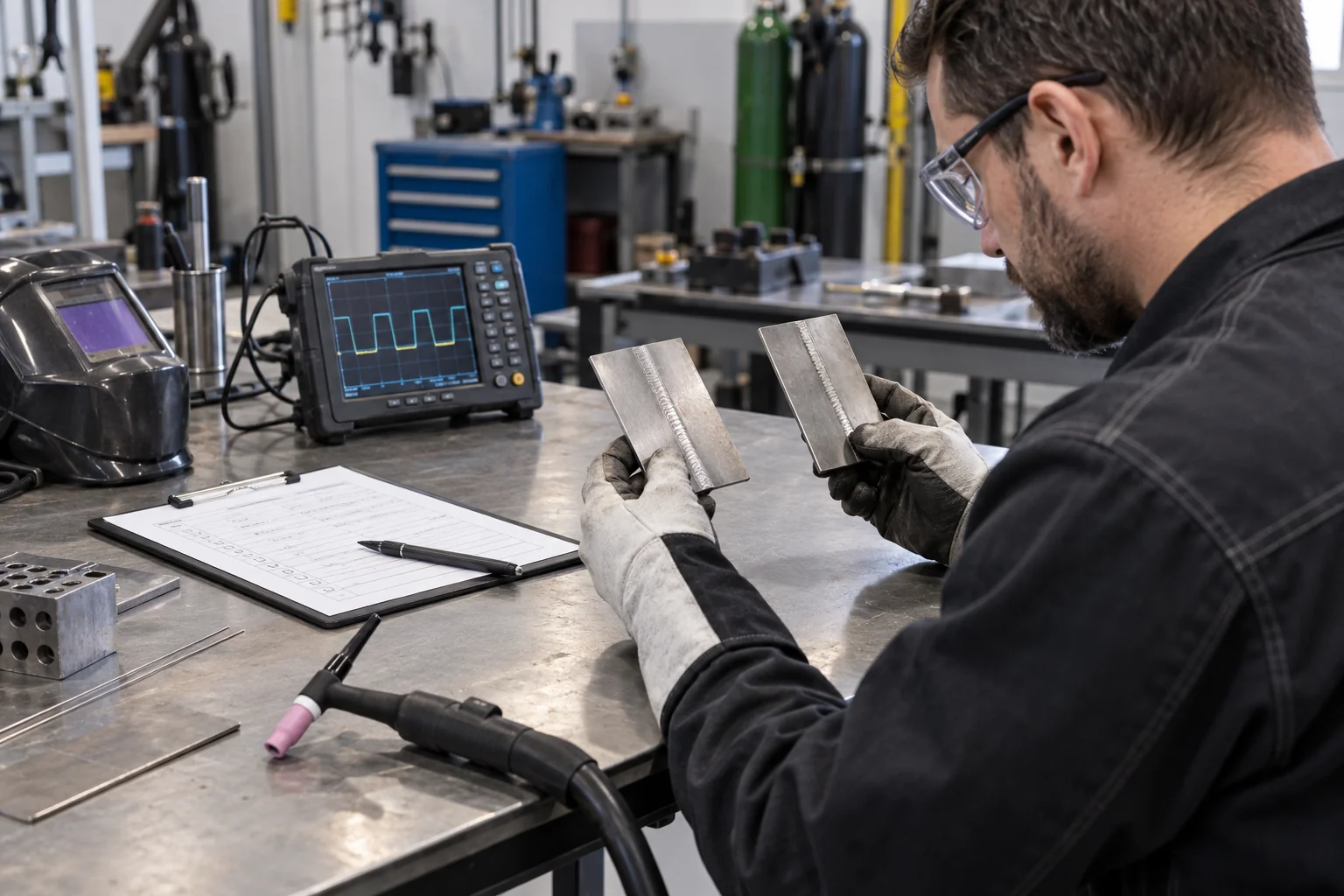
A factory acceptance test should confirm the delivered configuration against the order, then demonstrate the performance claims that matter to the application. The buyer and supplier should agree on instruments, load, environmental conditions, sample joints, inspection method and pass criteria in advance. The test may include visual checks, electrical safety checks performed under the applicable procedure, output measurements, stored-program recall and representative welding. Do not improvise electrical tests without qualified personnel and approved methods.| Acceptance item | Record to keep | Decision question |
|---|---|---|
| Identity and scope | Model, serial number, firmware and supplied accessories | Does the unit match the approved sample and order? |
| Pulse output | Set values, measured trace and measurement conditions | Does behavior meet the agreed method and tolerance? |
| Duty pattern | Arc-on schedule, ambient and observed protection response | Can the package sustain the specified work? |
| Weld samples | Procedure, material IDs and inspection results | Do representative welds meet project criteria? |
| Handover | Manuals, program backup, parts list and open items | Can the receiver install and service the system? |
 Document deviations and corrective actions before shipment. An accepted concession should be explicit; an open failure should not disappear into a generic “passed” line. For a large order, identify which tests apply to the first article, which apply to each batch, and which apply to every serialized unit.
Retest after relevant changes
If a production unit changes critical control hardware, firmware, torch configuration or output calibration, review the effect on the approved procedure and test plan. The size of retest should follow the risk, but the decision should be documented. This is a stronger control than relying on the same brochure throughout a multi-year purchase program.Compare OEM Support and Total Cost
Look beyond the unit price
Compare complete delivered scope, test documentation, installation support, spares, packaging, freight and service obligations. An inexpensive machine that requires an unlisted cooler or proprietary connector can become a more expensive station. A more capable control panel is not valuable if operators cannot repeat its settings or the service team cannot restore them after a repair. Build the cost comparison from your own expected arc-on hours, downtime exposure, operator training and inspection requirements. Ask the supplier for replaceable-part numbers and lead times, but do not convert unverified savings claims into a plant-wide return-on-investment figure. For distributors, evaluate how quickly a model-specific troubleshooting record can reach the end customer and whether spare parts remain available across batch changes.Define private-label responsibilities
An OEM pulse TIG welder program may require branding, manual language, carton design, regional electrical configuration and after-sales documentation. State who approves each item and who owns revision control. Ask for the sample-approval milestone, production inspection plan, permissible substitutions and defect-handling process. Do not assume that an OEM quotation includes every customization without an itemized schedule.Send GWELD a Pulse TIG Welder RFQ
Give the manufacturer enough context to respond precisely
GWELD's published range includes TIG 315/350P ACDC, TIG 400/500P ACDC 和 TIG 300/400/500 直流脉冲. These are candidate families, not promises that a particular configuration satisfies your WPS, site supply or throughput. Ask the GWELD team for the current datasheet and a written configuration matched to the application.- Base metals, thickness range, joint types and approved welding procedure.
- AC/DC requirement, intended pulse use, torch and cooling preferences.
- Typical current, longest arc-on interval, shifts and ambient conditions.
- Site voltage, phase, input constraints and installation space.
- Remote or automation signals, memory and data-record requirements.
- Quantity, destination, branding, documentation and required delivery window.
- Sample trial, inspection criteria and factory acceptance evidence.
Prepare the Receiving Team for Pulse TIG Deployment
Handover the procedure, not only the equipment
Factory approval is the beginning of control, not the end. Before a new pulse TIG fleet reaches the shop floor, assign an owner for the approved procedure, program library and operator training. Record the approved material, filler, gas, torch, cable and current range alongside the machine settings. A memorized program name by itself does not tell a new operator what joint or inspection standard it belongs to. Train receiving staff to inspect packaging, serial numbers, connectors and included accessories against the accepted order. A shipping discrepancy should be documented before the machine is installed or a substitute accessory is accepted. Keep a copy of the factory test record with the receiving record so later service teams can distinguish a delivery issue from a process change made on site.Make maintenance and retraining part of the rollout
A change in torch length, coolant arrangement, remote-control mode or firmware can affect the way a program behaves in practice. Give operators a simple escalation route when a stored setting no longer matches the approved instruction. Maintenance staff need the current connection drawing, replaceable-part list and safe troubleshooting process. If a repaired machine is returned to production, define which checks must be repeated before its programs are released again. For multi-site fleets, keep one central revision record but permit site-specific procedures where the actual jobs differ. Review reject rates, repair history and operator feedback after the first production period. Those records are more useful for the next purchasing decision than a general claim that pulse improves every weld. The manufacturer can support the rollout with documentation and technical discussion, while the buyer retains responsibility for project qualification and final weld acceptance.Common Pulse TIG Quotation Red Flags
Related Products

TIG 315/350P ACDC
A compact, air-cooled TIG/Stick inverter welder designed for AC and DC welding.
- 适用于饮水机.
- 采用更坚固耐用的材料。.
- 配备精选且可靠的附件,以提升焊工的体验。.
- 工业级焊机采用更高的冗余设计,可提高可靠性、延长使用寿命并增强耐用性。.

TIG 400/500P ACDC
A compact, air-cooled TIG/Stick inverter welder designed for AC and DC welding.
- 适用于饮水机.
- 采用更坚固耐用的材料。.
- 配备精选且可靠的附件,以提升焊工的体验。.
- 工业级焊机采用更高的冗余设计,可提高可靠性、延长使用寿命并增强耐用性。.

TIG 300/400/500 直流脉冲
A compact, air-cooled TIG/Stick inverter welder designed for AC and DC welding.
- 使用更坚固耐用的材料
- 适用于饮水机.
- 配备精选且可靠的附件,以提升焊工的体验。.
- 工业级焊机采用更高的冗余设计,可提高可靠性、延长使用寿命并增强耐用性。.
相关解决方案


重型制造
重工业严苛需求的终极TIG焊机解决方案。我们的设备采用坚固的材料和周到的研发,可提供高强度不锈钢接头所需的精确控制,以及厚碳钢深层熔透所需的可靠动力。体验专业性能,平衡设计,专为最苛刻的制造环境而打造。.

Frequently Asked Questions
Conclusion
The right TIG welder with pulse manufacturer should be able to connect the process requirement, the actual machine configuration and the factory evidence in one controlled purchasing package. Specify peak and background current, timing, AC/DC modes, operating limits and interfaces; test the agreed equipment on representative work; and preserve serial-number, program and change records for the fleet.
To evaluate a GWELD option, send your materials, production duty, site supply and OEM requirements to the GWELD team. Ask for a current model-specific technical schedule and an itemized quotation before comparing offers or approving a sample.