Stainless Steel Welding Machine: Industrial Buying Guide
Introduction
Choosing a 不锈钢焊机 for production is a system decision, not a contest for the highest amperage. A purchasing team must match the process to the joint, protect corrosion performance, prove the usable output over a real shift, and agree on the torch, gas and service package that will actually arrive.
This guide helps fabrication plants, pipe contractors and OEM buyers specify a TIG-focused stainless steel welding setup, compare DC pulse options, plan a representative acceptance trial and send GWELD a useful request for quotation. Welding parameters and filler choices still require an approved procedure and qualified personnel.
What a Stainless Steel Welding Machine Must Deliver
Define the production result before the equipment
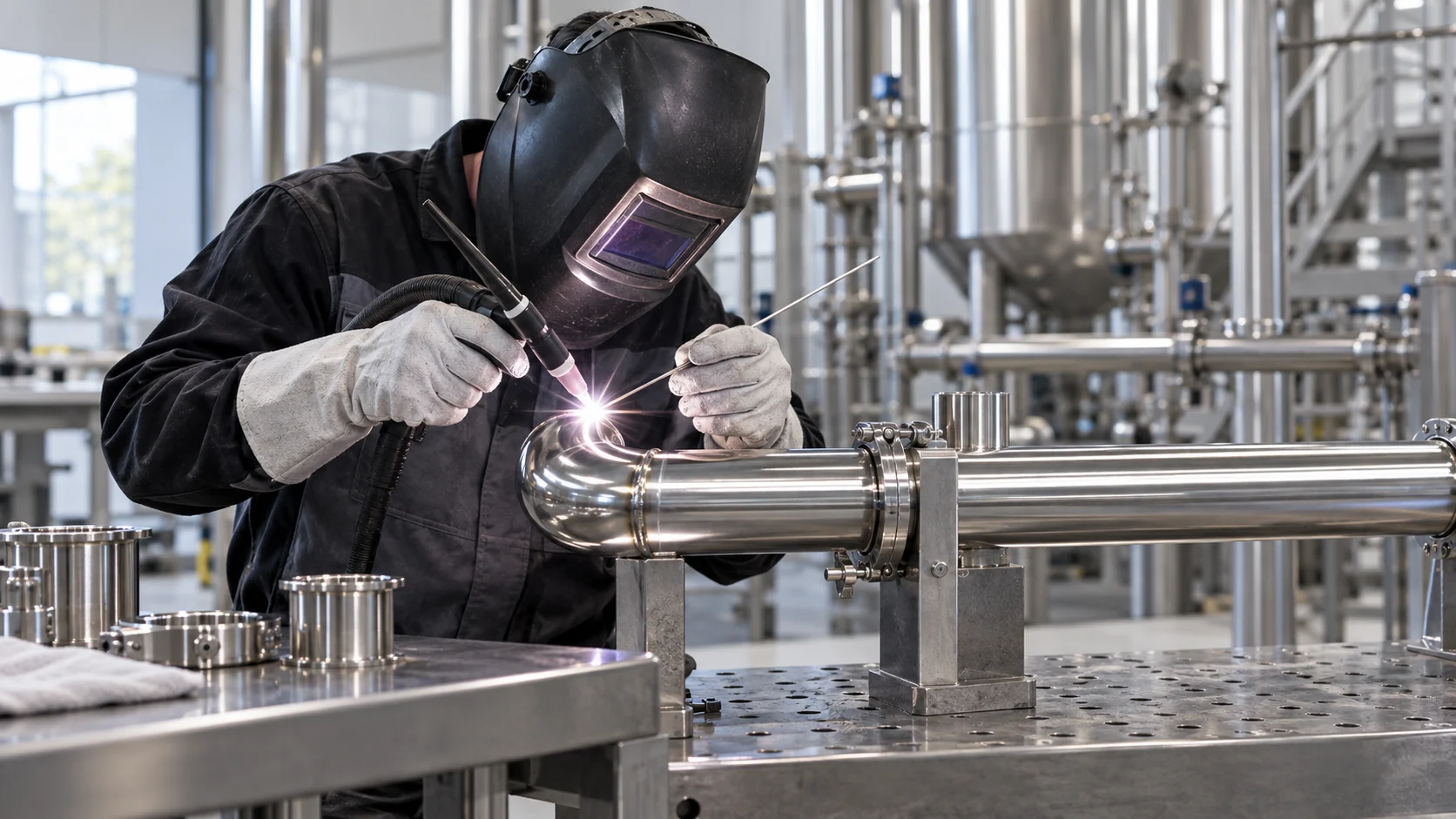
A buyer searching for a 不锈钢焊机 may be comparing a power source, a complete TIG workstation or a multi-process fabrication cell. Those are different purchases. Write down the stainless grade, thickness range, joint geometry, position, expected weld appearance and inspection method before requesting a model. A sanitary tube root pass, a sheet-metal enclosure and a thick structural bracket impose different control and throughput requirements.
The specification should separate weld quality from equipment features. Corrosion performance depends on material, filler, shielding, surface condition and procedure as well as the machine. A stable low-current arc helps with delicate work, while long arc-on periods require usable output and thermal management. Neither a high display number nor a polished demonstration bead proves a production fit.
Name the delivered system
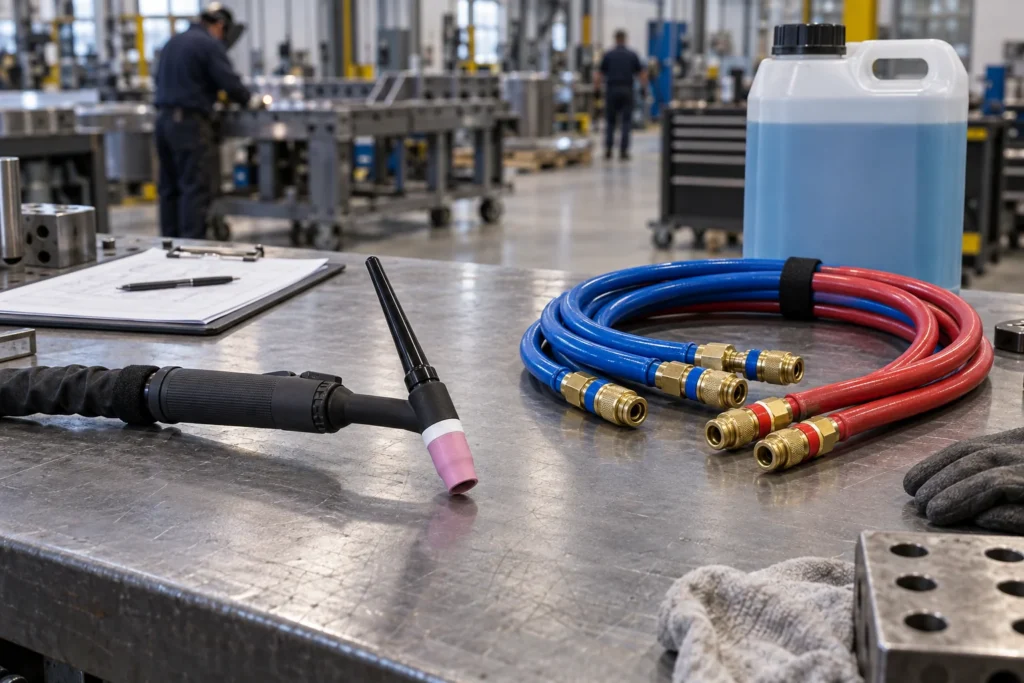
Ask whether the offer includes a compatible torch, leads, regulator, foot control, cooling unit, filler-feed interface, initial consumables and documentation. If any item is optional, identify it in the quotation. Use GWELD’s TIG welder range as a starting point, then request the current model-specific configuration rather than assuming every catalog feature is supplied.
Choose TIG, MIG or Stick for Stainless Production
Use TIG where control and access matter
Gas tungsten arc welding is often selected for thin stainless sheet, visible joints and high-integrity pipe roots because the operator can control the arc and filler separately. A DC TIG power source with a stable starting and low-current range may be more important than a high peak rating for a small sanitary fitting. The correct decision still depends on the approved welding procedure, productivity target and joint access.
Compare deposition and field constraints honestly
MIG/GMAW may suit longer, higher-deposition joints where the qualified process, cleanliness and access allow it. Stick/SMAW can serve certain field repairs but brings different slag and finish requirements. Do not describe one process as universally better for stainless. Compare accepted welds per shift, repair time, access to the joint and the number of procedure qualifications needed. Our TIG versus MIG process guide explores the wider factory trade-off.
A multi-process purchase is useful only if the modes and accessories actually cover the project. Specify which processes are essential, which are occasional backup and which would require a separate machine. This prevents a broad marketing label from masking a missing production function.
Specify DC Output and Pulse Control for Stainless Steel
Start with DCEN and the approved procedure
Stainless TIG commonly uses direct current electrode negative under an approved procedure. Lincoln Electric’s TIG process guidance describes DC electrode negative with argon protection for steel applications. Confirm the exact polarity, filler, tungsten, gas and settings through the applicable WPS; do not copy a generic amperage chart into a critical job.
Treat pulse as a controllable process variable
A DC pulse TIG welding machine alternates peak and background current. Ask whether peak, background, frequency and time-at-peak are independently adjustable on the proposed model. Record the useful range on representative joints, not just the maximum advertised frequency. Pulse can help control the puddle and manage distortion in some stainless applications, but it does not guarantee lower heat input without considering travel speed and total procedure.
The operator needs repeatable start, slope, crater and post-flow behavior as much as a pulse menu. Test a restart on a warm joint and inspect both the start and termination. Miller’s stainless pulse TIG discussion provides process context; its product-specific claims should not be read as GWELD specifications.
Match the Machine to Grade, Thickness and Joint
Use a joint matrix rather than one headline thickness
Record 304/304L, 316/316L or other grades separately, along with actual wall or sheet thickness, fit-up variation, weld position and service environment. An equipment comparison should include the thinnest practical joint, the highest continuous-current joint and the most access-limited joint. A machine that performs beautifully on a flat coupon may behave differently around a small tube or restricted corner.
Filler selection is a procedure and metallurgy decision, not an automatic machine feature. Our stainless TIG filler-wire guide explains how to start a material discussion. Ask the welding engineer to approve filler classification and diameter against the base metal, service requirements and project documents. Keep lot traceability and storage conditions in the purchasing schedule.
Separate power-source capability from package fit
Confirm torch reach, cable length, remote-control method and shielding access on the actual fixture. A low-current range may be useful for thin assemblies, while thick joints can make torch cooling and duty pattern decisive. If the plant also welds aluminum, an AC/DC platform may offer broader fleet flexibility, but a stainless-only cell need not pay for unneeded modes. GWELD lists both compact DC pulse 和 higher-output DC pulse families for model-specific review.
Compare Output, Duty Cycle and Site Power
Read the conditions behind every rating
A peak-current number is not a continuous-production promise. Request the rated welding current, voltage, duty cycle, ambient test condition and input requirement for the exact model. Compare that evidence with the longest expected arc-on interval, breaks between joints and local temperature. If a quotation claims continuous operation, ask for a witnessed duty-pattern demonstration at the agreed output rather than relying on a label.
Check site phase, voltage range, breaker, plug, grounding and generator conditions with the plant electrician. A machine that works on a supplier’s bench can trip a site circuit or derate under a weak supply. Include cable length and extension practices in the assessment. The GWELD product pages are useful candidate references, but published descriptions are not a substitute for the current datasheet and order-specific rating.
Compare like for like
| RFQ item | Buyer should specify | Evidence to request |
|---|---|---|
| Output | Typical and peak welding current at actual joints | Model rating sheet and sample-weld record |
| Duty pattern | Arc-on interval, shift length, ambient temperature | Rated duty conditions and representative trial |
| Input | Voltage, phase, protection and cable arrangement | Installation manual and connection drawing |
| Control | Start, pulse, remote and stored-setting needs | Current model manual and demonstrated setup |
| Package | Torch, cooler, regulator and service spares | Itemized quotation and accessory list |
Do not accept a rating table copied from a different product family. Record the test conditions and any limitations on simultaneous features.
Plan Torch Cooling, Gas and Back Purge
Design around the longest real weld
Torch temperature can limit production before the power source reaches its advertised output. Match torch duty rating, head size, cable reach and consumables to the current and operator access. For repeated high-current work, ask whether a water-cooled torch and compatible cooler are required, included or optional. The buyer should review coolant compatibility, flow monitoring, maintenance and spare hoses as part of the system, not as afterthoughts. Our water-cooled TIG system guide provides an equipment-level checklist.
Control shielding on both sides where required
Argon shielding, gas cup selection, flow, preflow and postflow must suit the joint and approved procedure. Stainless tube roots may need an internal purge to protect the back side of the weld. Miller’s stainless tube and pipe guidance discusses heat, filler, cleanliness and traditional argon back purging. The actual purge method and oxygen acceptance criterion belong in the project procedure, not in a generic equipment advertisement.
Confirm regulator, gas-lens parts, purge tooling and spare ceramics in the delivered scope. Air movement and fixture geometry can change coverage, so verify shielding on a representative part. Purchasing only the power source cannot solve an incomplete gas plan.
Protect Stainless Cleanliness and Traceability
Prevent cross-contamination before welding
Separate stainless handling from carbon-steel grinding and brushing. Dedicated brushes, abrasives, fixtures and clean storage reduce the chance of embedded contamination that later appears as discoloration or corrosion. Record who supplies preparation tools and how workpieces are identified. A machine trial on pristine material should not be used to approve an uncontrolled production flow.
Make the consumable chain auditable
Maintain filler classification, batch number and material certificate where the contract requires traceability. Track shielding-gas specification and changeover practice. Ask whether tungsten preparation, torch consumables and spares are available locally; our TIG tungsten selection guide 和 torch-parts buying guide cover related procurement controls.
这 不锈钢焊机 does not create traceability by itself. If the factory needs procedure records, define whether the operator records settings manually, the power source stores programs, or the cell exports data. Verify the feature on the exact quoted version and agree who owns the records after delivery. Avoid treating a generic digital display as proof of an auditable system.
After welding, define the required surface condition before choosing a finishing process. Our weld cleaning machine buying guide explains how to compare equipment, plan representative trials and distinguish visible heat-tint removal from agreed passivation verification.Check Controls, Automation and Fleet Standardization
Test the human interface
Ask an experienced operator to set up the three most common jobs using the proposed controls. Verify current adjustment, pulse settings, start sequence, remote pedal or torch switch behavior, memory recall and the ability to prevent accidental changes. A menu with many features can still slow production if critical settings are difficult to identify or a saved program has no controlled name and revision.
Specify interfaces before promising automation
If the production plan includes a positioner, wire feeder or robotic cell, identify the start/stop, current command, fault feedback and data signals actually required. Obtain a connection drawing and a model-specific compatibility statement. Do not assume a communications protocol is fitted merely because it appears on another GWELD page or in an optional marketing description. Test the complete cell with the intended torch and feeder before accepting it.
For a multi-site fleet, standardize accessories, procedures, spare boards and training material where possible. Allow site-specific configurations only where the work or electrical supply genuinely differs. The GWELD general fabrication solution can frame a workshop-level discussion, while the final supply schedule should list each site’s exact model and options.
Run a Representative Stainless Weld Acceptance Trial
Agree the test before choosing the sample
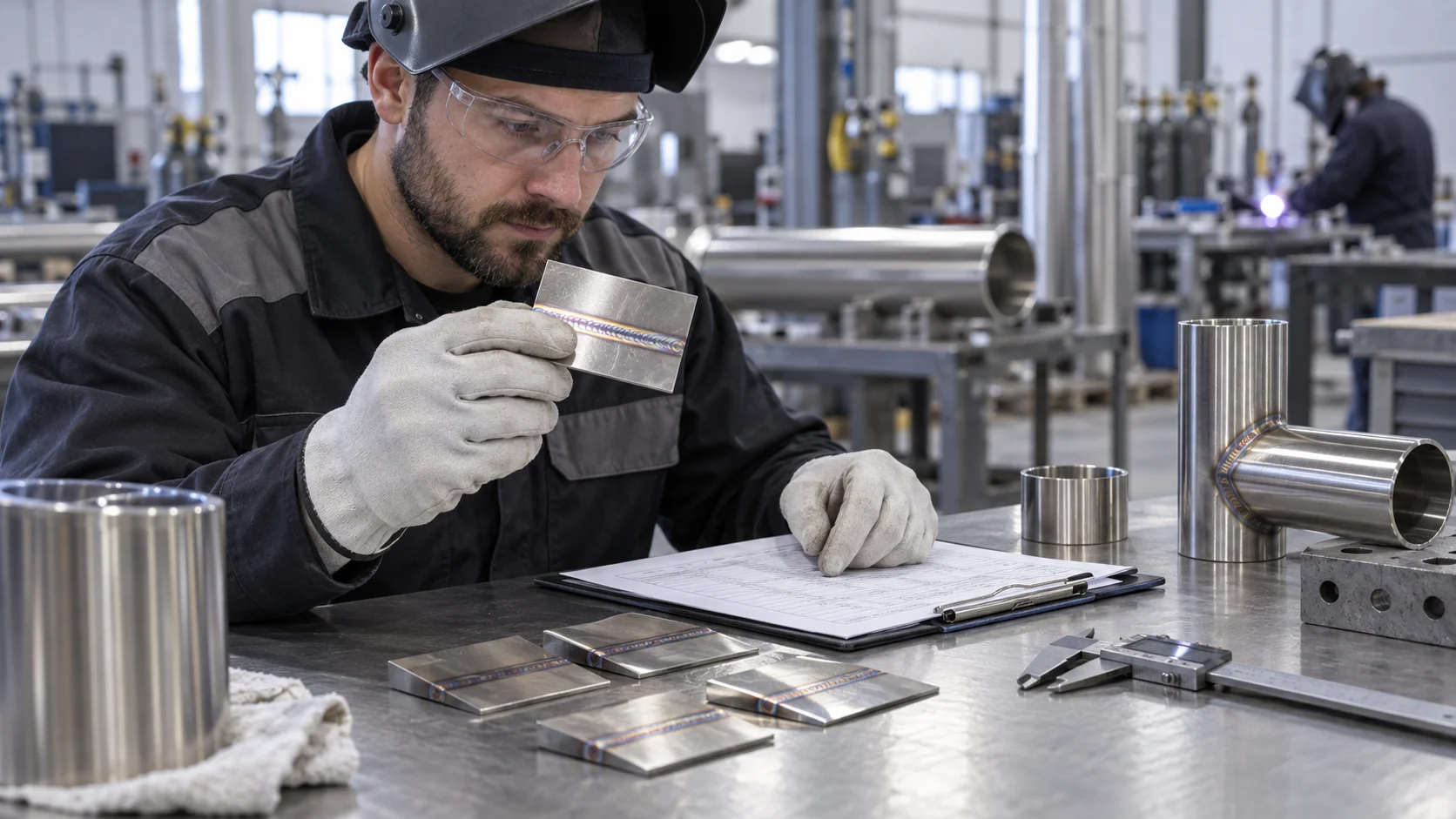
A factory acceptance test should begin with the buyer’s material, thickness, joint design, position, filler, shielding and inspection method. Agree which variables may change during the trial and who records them. Include a difficult but normal production joint, not only a flat demonstration coupon. If a procedure qualification is required, a qualified welding engineer should own that process; equipment approval is not itself a WPS or PQR approval.
Run the cell through the expected duty pattern. Observe start and stop behavior, pulse stability, torch heat, restart after a pause and repeatability after a power cycle. Record the machine serial number, software revision if applicable, accessories, input conditions and actual settings. Compare weld results against pre-agreed criteria such as visual inspection, dimensional checks or additional examination required by the project.
Keep evidence useful after delivery
Ask for signed acceptance records, photographs of the tested configuration, instrument information where relevant, deviations and corrective actions. The purpose is not to collect the largest possible file; it is to establish that the ordered system matches the approved sample. When shipment arrives, receiving staff should verify the serial number, supplied accessories and documents before releasing the machine to production.
Evaluate Serviceability and Total Cost of Ownership
Count downtime, not only purchase price
The cheapest quoted machine can become expensive if it delays a pipe line, consumes extra inspection time or requires an unavailable torch part. Compare cost per accepted weld or cost per productive hour using a realistic shift. Include power-source price, cooling package, torches, regulators, consumables, spares, training, shipping, import costs and planned maintenance. Keep uncertain figures as assumptions rather than promises of savings.
Ask who provides technical support, which parts are stocked, how a fault is diagnosed and what evidence is needed for a warranty claim. The current warranty term must be confirmed in the actual quotation because public product pages can differ. A supplier response should name responsible contacts and expected steps, not just say “lifetime service.” For large fleets, request a recommended spare kit and a repair or replacement turnaround path.
Make a comparison the team can audit
| Cost or risk | Measure for the comparison | Decision owner |
|---|---|---|
| Purchase scope | Itemized machine and accessory package | Purchasing |
| Production loss | Trial cycle time and accepted weld rate | Production |
| Quality cost | Inspection and repair hours per batch | 质量 |
| Service risk | Parts route, response and spare strategy | Maintenance |
| Deployment | Training, site power and commissioning | Engineering |
Use the same assumptions for every bidder. A favorable sample made under a different operator, fixture or inspection method cannot support a fair lifetime-cost comparison.
Prepare a Stainless Welding Machine RFQ
Send production facts, not just a target amperage
A useful RFQ lets GWELD respond with an appropriate family and an itemized package. Specify base-metal grades, thickness and joint range, approved process, production rate, site power, expected arc-on intervals, ambient conditions and installation location. Attach a drawing or representative photograph of the joint if sharing is permitted. State whether the purchase is a sample, a single production cell or a standardized fleet.
- Required TIG modes, pulse controls and acceptable low-current behavior.
- Torch type and reach, air or water cooling, regulator and gas/purge accessories.
- Foot control, torch switch, feeder or automation interfaces and memory needs.
- Inspection, sample-weld and factory-acceptance evidence.
- Order quantity, destination, delivery window, spare parts and service expectations.
Request a model-specific datasheet, included-accessory list, optional-item prices, rating conditions, installation requirements and warranty terms. Ask GWELD to identify any requirement it cannot meet so the team can make an explicit decision. Start with the GWELD product portfolio and the technical inquiry form; do not assume a product card represents a complete welding station.
Common Buying Mistakes to Avoid
Do not equate a pulse label with a qualified process
Pulse can be valuable for stainless work, but the word alone says nothing about adjustable ranges, heat behavior or accepted weld quality. Require a model-specific demonstration against the approved procedure. A claim about corrosion resistance should be tied to material, filler, shielding, purge, preparation and inspection; no power source can guarantee it in isolation.
Do not approve a system from an incomplete quote
A power-source-only price may omit the correct torch, cooler, remote, gas accessories or feeder interface. Ask for an itemized scope and a drawing of the as-supplied system. Confirm the input supply at the plant and check the longest realistic weld rather than only the peak output. Treat unverified marketing claims—especially duty cycle, automation interfaces and warranty—as questions for the written contract.
Do not lose the approved configuration during rollout
Keep the sample settings, serial-number record, accessory list and inspection result together. When an apparently equivalent torch or control board is substituted, define when engineering must reapprove the process. After delivery, monitor rejects, maintenance events and operator feedback so that the next order uses evidence from the real cell rather than a general product ranking.
Stainless Steel Welding Machine Selection Checklist
Use this final gate before purchase approval
- The project’s stainless grades, thickness, joint access and quality criteria are documented.
- TIG, MIG or Stick selection is linked to an approved process and productivity target.
- DC output, pulse controls and the real duty pattern are verified for the chosen model.
- Torch, cooler, gas delivery and purge requirements are included or explicitly excluded.
- Filler, tungsten, preparation tools and traceability responsibilities are assigned.
- A representative weld trial and inspection plan have agreed acceptance criteria.
- Site power, interfaces, spares, warranty and after-sales route are in writing.
- The itemized quote matches the tested configuration and delivery schedule.
This checklist is a purchasing control, not a welding instruction. Confirm final procedure settings, code compliance and acceptance with the project’s responsible welding professionals. A precise request enables GWELD to recommend a better-matched equipment package and gives every stakeholder a common basis for sign-off.
Related Products

TIG 300/400/500 直流脉冲
A compact, air-cooled TIG/Stick inverter welder designed for AC and DC welding.
- 使用更坚固耐用的材料
- 适用于饮水机.
- 配备精选且可靠的附件,以提升焊工的体验。.
- 工业级焊机采用更高的冗余设计,可提高可靠性、延长使用寿命并增强耐用性。.

TIG 180/200/225 直流脉冲
A compact, air-cooled TIG/Stick inverter welder designed for AC and DC welding.
- 采用耐用的内部组件和加固结构,确保长期可靠性。.
- 支持TIG脉冲和焊条焊接不锈钢、碳钢、铜及其他常见金属。.
- 紧凑便携的设计,适用于车间、车库、移动维修和日常制造工作。.

TIG 315/350P ACDC
A compact, air-cooled TIG/Stick inverter welder designed for AC and DC welding.
- 适用于饮水机.
- 采用更坚固耐用的材料。.
- 配备精选且可靠的附件,以提升焊工的体验。.
- 工业级焊机采用更高的冗余设计,可提高可靠性、延长使用寿命并增强耐用性。.
相关解决方案


重型制造
重工业严苛需求的终极TIG焊机解决方案。我们的设备采用坚固的材料和周到的研发,可提供高强度不锈钢接头所需的精确控制,以及厚碳钢深层熔透所需的可靠动力。体验专业性能,平衡设计,专为最苛刻的制造环境而打造。.

管道
专为关键管道制造和现场管道施工而设计的终极 TIG 焊机解决方案。我们采用深思熟虑的研发驱动,并使用重型实心材料制造,我们的机器可提供对不锈钢完美 5G/6G 起始焊缝所需的精确电弧控制,以及对碳钢管道深熔填充焊缝所需的可靠动力。通过专为世界上最苛刻的能源和工艺管道项目而设计的平衡设计,实现 X 射线质量的接头和最大的正常运行时间。GWELL 确保您的团队始终能够提供专业性能,消除昂贵的现场返工。.
Frequently Asked Questions
Conclusion
The best 不锈钢焊机 is the one that delivers an approved weld on the actual joint throughout the planned duty pattern, with a complete torch, gas, cooling and service package. Choose the process first; verify DC and pulse behavior, shielding and purge, site power, traceability and sample performance before comparing prices. A clear acceptance record makes the later production rollout easier to control.
GWELD offers DC pulse and AC/DC TIG families that can be evaluated against your stainless application. Send GWELD your material, thickness, joint drawing, production duty and site requirements to request a current model-specific proposal, itemized accessories and an agreed trial plan. Final settings, qualification and weld acceptance remain with the responsible project professionals.