TIG Welding Stainless Steel: Pipe, Pulse & Purging Guide
Introduction
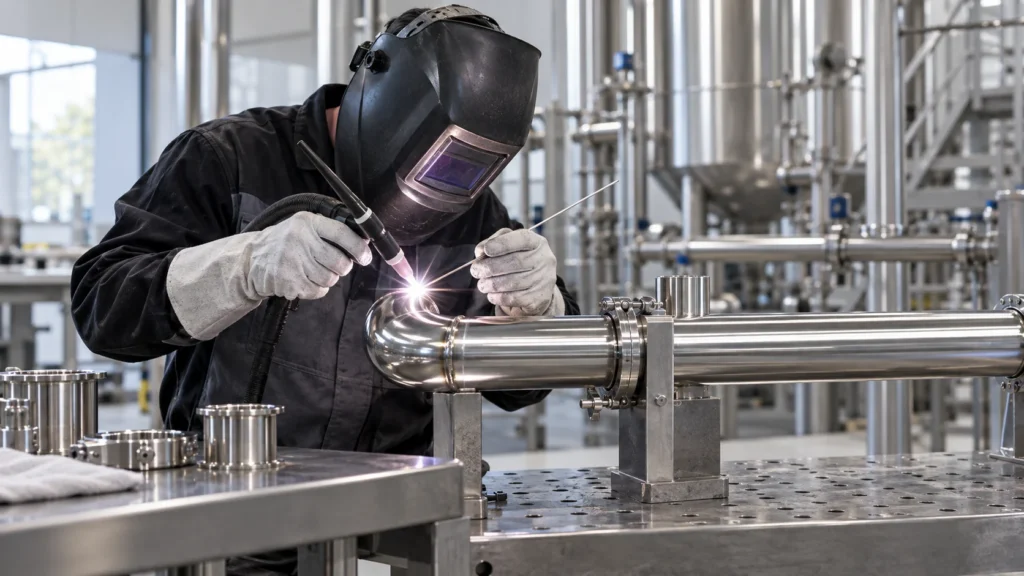
TIG welding stainless steel requires control of heat input, shielding, joint cleanliness and filler selection. DC electrode-negative output and argon shielding are common choices, but final settings must follow the material, joint and qualified welding procedure.
This guide focuses on stainless steel pipe and pulse TIG: how to plan heat control, root protection and a documented setup. If you are selecting equipment, use the stainless steel welding machine buying guide for model-specific procurement checks.
Heat Input, Cleanliness and Corrosion Requirements
Stainless steel weld quality depends on the complete procedure, including material grade, joint preparation, heat input and the required surface condition. Do not treat a clean-looking bead as proof of corrosion performance or code compliance.
Before welding
- Confirm base-metal grade, filler classification and the applicable procedure.
- Keep preparation tools and consumables free from carbon-steel contamination.
- Control fit-up, arc length, travel and weld sequence; measure interpass temperature where required.
- Define heat-tint, inspection and post-weld treatment acceptance criteria before production.
TWI’s heat-tint guidance explains why weld oxidation needs consideration alongside corrosion requirements. Select any cleaning process against the job specification.

Pulse TIG Settings: What to Record and Validate
Pulse TIG alternates peak and background current. Frequency, peak-time fraction, current levels and travel speed work together; increasing frequency alone does not guarantee lower distortion or faster output.
Record the complete pulse setup
- Machine model, available pulse range and control mode
- Peak current, background current, frequency and peak-time fraction
- Electrode and filler size, joint fit-up and welding position
- Travel speed, acceptance results and heat-input requirements
Compare a controlled sample with the existing approved process. Use the pulse TIG manufacturer buying guide to request model-specific control and factory-test evidence.
Stainless Steel Pipe Back Purging and Root Protection
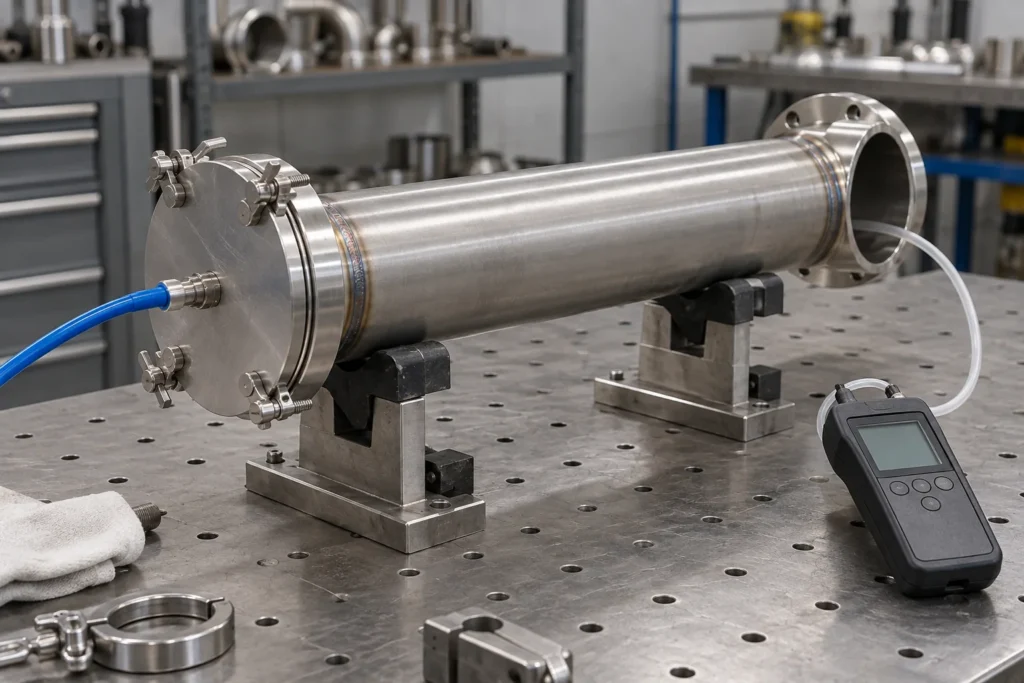
Back purging protects the hot root of a stainless steel pipe weld where the procedure requires it. Seal the purge zone, provide an appropriate vent and verify gas delivery rather than relying only on elapsed purge time.
Use project-specific acceptance limits
Required residual oxygen, purge duration and inspection criteria depend on the alloy, service, joint and project specification. There is no single oxygen threshold that proves compliance for every stainless steel pipe job.
- Confirm purge gas, fixture arrangement, leakage control and monitoring requirements.
- Maintain protection through the stages specified by the welding procedure.
- Record the root condition and required inspection results before scaling production.
Review Miller’s stainless tube and pipe guidance and our TIG shielding gas guide for setup considerations.

Stainless Steel TIG Setup Record: Procedure Checklist
This chart is a documentation checklist, not a verified amperage recipe or a substitute for a qualified welding procedure.
| Setup item | Record before production | Approval check |
|---|---|---|
| Material and joint | Grade, thickness, fit-up and welding position | Match the qualified procedure and service requirements |
| Power source | Model, polarity, current and pulse controls | Confirm actual available modes and output evidence |
| Consumables | Tungsten classification and filler specification | Check identification, diameter and traceability |
| Gas shielding | Gas type, torch flow, cup and root protection | Validate coverage and project-specific purge criteria |
| Thermal control | Travel, sequence and interpass checks | Stay within procedure requirements |
| Inspection | Acceptance method and sample results | Obtain the required engineering approval |
Use our stainless steel TIG filler selection guide alongside the electrode and machine documentation.
How to Compare Continuous and Pulsed TIG
Compare processes on representative parts under controlled conditions. Pulse is an option to evaluate, not an automatic quality guarantee.
| Evaluation | Continuous DC TIG | Pulsed DC TIG |
|---|---|---|
| Controls to record | Current and travel | Peak/background current, frequency, peak-time fraction and travel |
| Quality checks | Required joint and inspection criteria | The same joint and inspection criteria |
| Cost comparison | Accepted output, labor, gas and rework | Accepted output, labor, gas and rework under the trial settings |
Do not infer a fixed distortion reduction, travel-speed gain or NDT success rate from the presence of pulse controls alone.
Illustrative Stainless Pipe Qualification Workflow
This workflow is illustrative; it is not a documented GWELD customer case or a guaranteed production result.
- Agree material, joint, service and inspection requirements with the responsible welding engineer.
- Confirm the machine, torch, filler, gas and root-protection arrangement.
- Document a representative sample, including pulse controls and thermal checks where applicable.
- Assess the sample against the required procedure and acceptance criteria.
- Release a controlled setup record and compare accepted output and rework during production.
Related Products

TIG 180/200/225 直流脉冲
A compact, air-cooled TIG/Stick inverter welder designed for AC and DC welding.
- 采用耐用的内部组件和加固结构,确保长期可靠性。.
- 支持TIG脉冲和焊条焊接不锈钢、碳钢、铜及其他常见金属。.
- 紧凑便携的设计,适用于车间、车库、移动维修和日常制造工作。.

TIG 180/200/225P ACDC
A compact, air-cooled TIG/Stick inverter welder designed for AC and DC welding.
- 专为铝焊设计,精确控制细薄易损材料。.
- 先进的脉冲技术有助于减少热输入并改善焊缝外观。.
- 采用耐用组件和坚固结构,确保长期可靠性。.
TIG 300/400/500 直流脉冲
A compact, air-cooled TIG/Stick inverter welder designed for AC and DC welding.
- 使用更坚固耐用的材料
- 适用于饮水机.
- 配备精选且可靠的附件,以提升焊工的体验。.
- 工业级焊机采用更高的冗余设计,可提高可靠性、延长使用寿命并增强耐用性。.

TIG 315/350P ACDC
A compact, air-cooled TIG/Stick inverter welder designed for AC and DC welding.
- 适用于饮水机.
- 采用更坚固耐用的材料。.
- 配备精选且可靠的附件,以提升焊工的体验。.
- 工业级焊机采用更高的冗余设计,可提高可靠性、延长使用寿命并增强耐用性。.

TIG 400/500P ACDC
A compact, air-cooled TIG/Stick inverter welder designed for AC and DC welding.
- 适用于饮水机.
- 采用更坚固耐用的材料。.
- 配备精选且可靠的附件,以提升焊工的体验。.
- 工业级焊机采用更高的冗余设计,可提高可靠性、延长使用寿命并增强耐用性。.
相关解决方案

维护与维修
为应对不可预测的维修需求而打造的终极 TIG 焊机解决方案。我们的设备采用坚固的材料和周到的研发,可提供精密的电弧控制,满足精致不锈钢维修的要求,同时还能提供可靠的动力,用于崎岖场地的维修。体验专业性能,尽享平衡的设计,它紧凑、便携,并经过精心设计,可让您的操作随时准备就绪,无论身处何地。.

海上
终极 TIG 焊机解决方案,适用于最严苛的海洋环境。我们的机器采用坚固的材料和周密的研究与开发制造,能够承受潮湿和盐雾,同时提供精密电弧控制,满足关键海上基础设施的需求。在一个平衡的设计中体验专业性能,即使在浮动平台或偏远船厂也能保持可靠——确保您在任务关键时始终做好准备。.

管道
专为关键管道制造和现场管道施工而设计的终极 TIG 焊机解决方案。我们采用深思熟虑的研发驱动,并使用重型实心材料制造,我们的机器可提供对不锈钢完美 5G/6G 起始焊缝所需的精确电弧控制,以及对碳钢管道深熔填充焊缝所需的可靠动力。通过专为世界上最苛刻的能源和工艺管道项目而设计的平衡设计,实现 X 射线质量的接头和最大的正常运行时间。GWELL 确保您的团队始终能够提供专业性能,消除昂贵的现场返工。.
Conclusion: Qualify the Process, Then Select the Equipment
For TIG welding stainless steel, choose equipment that supports the approved procedure and actual production duty. Shielding, filler selection, root protection and inspection remain part of the decision.
Send material grade, wall thickness, joint type, required pulse controls, cooling arrangement and duty pattern to the GWELD equipment consultation team. Request model-specific documentation rather than relying on universal parameter or pass-rate promises.