TIG Welder Torch: Industrial Production Fleet Guide | GWELD
The thermal management and electrical conductivity efficiency of a premium tig welder torch network represent the thin margin between flawless radiographic weld compliance and catastrophic factory line downtime. Across demanding high-volume industrial fabrication environments—spanning European automotive chassis assembly lines, Middle Eastern high-pressure oil and gas pipe fabrication yards, and heavy marine infrastructure facilities in Southeast Asia—the torch is not merely a consumable accessory. It is the critical final node of energy delivery within the advanced plasma arc matrix.
For manufacturing plant managers, welding engineers, and technical procurement directors, acquiring high-performance hardware requires looking past standard retail brochures. Maximizing localized workshop duty cycles, streamlining parts interchangeability for mixed machinery fleets, and ensuring operator safety under continuous shifts requires a thorough, data-driven engineering analysis of fluid dynamics, metallurgical composition, and ergonomic control integration.
Thermodynamic Classifications: Gas-Cooled vs. Water-Cooled System Engineering
At the baseline of factory asset allocation, procurement committees must systematically segment their torch infrastructure based on the thermodynamic demands of their manufacturing lines. The primary factor governing torch survivability is its method of heat dissipation during extended duty cycles.
Gas-Cooled (Air-Cooled) Torch Systems
Gas-cooled torch networks utilize the ambient shielding gas flow (typically pure Argon) running through the power cable and torch head to cool the internal copper conductors. These systems are highly optimized for portability, on-site field maintenance, and structural pipeline root runs where current thresholds remain below 150 to 200 Amperes.
The clear structural advantage of gas-cooled hardware is the absence of complex fluid plumbing, making them highly resilient for outdoor construction environments. However, their physical limitation involves rapid thermal accumulation under continuous high-amperage usage, which can accelerate handle degradation if pushed past design limits.
Liquid/Water-Cooled Torch Systems
For heavy industrial manufacturing facilities running automated gantry networks, thick-plate pressure vessel joining, or continuous multi-shift production lines above 250 Amperes, liquid-cooled setups are mandatory. These systems deploy a continuous closed-loop fluid circuit that pumps specialized low-conductivity coolant directly into the internal brass torch head cavity, circulating fluid along the primary electrical power leads.
The total heat dissipation capacity of a liquid-cooled loop is calculated via the thermodynamic fluid flow equation:
Q = m x c x Delta T
Where:
-
Q represents the total net heat energy dissipated per minute.
-
m represents the mass flow rate of the coolant fluid passing through the torch head core.
-
c represents the specific heat capacity metric of the selected coolant fluid composition.
-
Delta T represents the temperature differential between the incoming cold fluid line and the returning hot line.
By maintaining high mass flow rates through specialized internal channels, liquid-cooled systems effectively stabilize torch head temperatures, preventing high-temperature deformation of internal silicone rubber insulation layers and allowing a certified 100% duty cycle at 350 to 500 Amperes. To evaluate the full manufacturing matrix of heavy industrial inverter power platforms engineered to pair with these high-output fluid loops, review the GWELD Full-Spectrum Industrial Equipment Manufacturing Hub.

Global Fleet Supply Chain Standardization: Standardized Interoperable Consumable Systems
A common operational error that increases the total cost of ownership (TCO) inside mixed machinery environments is inventory fragmentation of essential parts. Large-scale factories routinely operate diverse machinery fleets across their production floor.
Without strict supply chain control during procurement, warehouse managers can find themselves stocking dozens of non-interchangeable collets, back caps, and gas lenses, which increases storage costs and causes production delays.
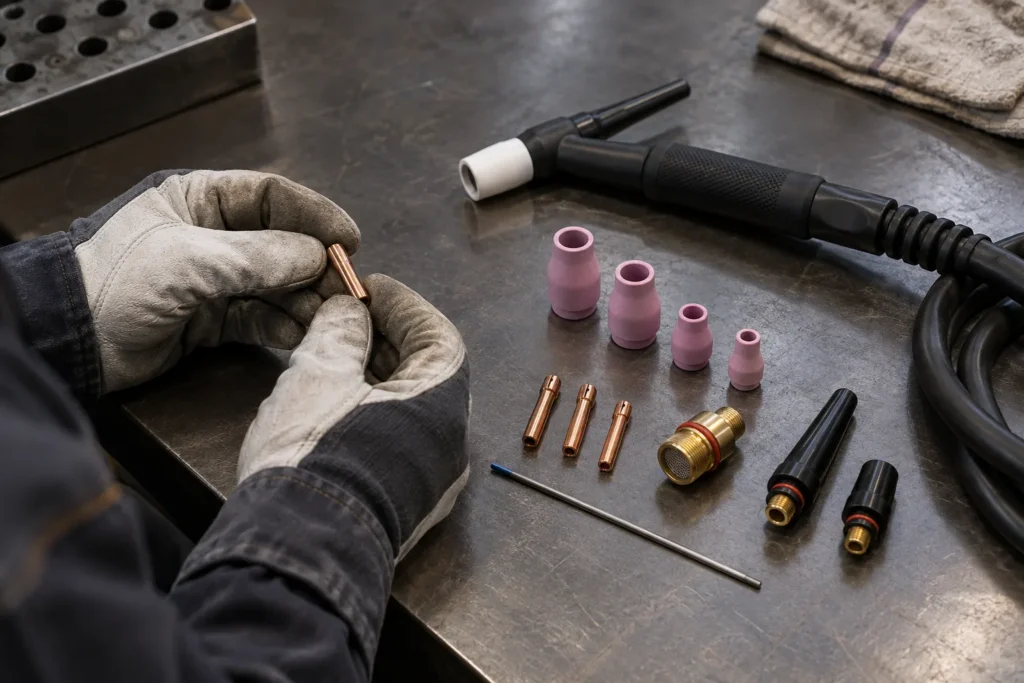
The universal standard baseline for industrial TIG torch consumable stacking follows a strict geometric sequence:
Back Cap Configuration - Silicone Insulator Shield - Collet Body or Gas Lens Core - Alumina Cup Nozzle
The international fabrication marketplace relies on two standard internal geometries: the WP-9/20 series (optimized for precision low-amperage lines) and the WP-17/18/26 series (engineered for high-amperage structural applications).
Standardizing your procurement tracks around these universal geometries ensures that your inventory of tig welder torch parts remains fully interchangeable, regardless of the brand name printed on the power source chassis.
Premium Gas Lens Configurations vs. Standard Collet Bodies
When configuring an industrial torch fleet for high-precision manufacturing, technical directors should mandate the deployment of premium gas lens assemblies over basic, low-cost collet bodies. A standard collet body ejects the shielding gas from the alumina nozzle in a turbulent, disorganized stream. This chaotic flow pattern quickly draws in ambient oxygen and nitrogen, leading to micro-porosity defects in sensitive molten metal pools.
In contrast, an advanced gas lens assembly incorporates a series of high-purity concentric stainless steel mesh screens that flatten the gas velocity profile, creating a highly controlled, parallel laminar flow envelope. This stable shielding curtain offers three distinct production advantages:
-
Extended Tungsten Stick-Out: Operators can extend the non-consumable electrode up to 25 mm past the nozzle rim, granting excellent visibility inside deep V-groove roots and tight structural corners.
-
Drastic Shielding Gas Savings: Laminar flow distribution maintains an uncompromised atmospheric seal at significantly lower volumetric flow rates, cutting total factory Argon consumption by up to 20% to 30%.
-
Flawless Surface Chemistry Protection: Eliminating atmospheric contamination ensures pristine surface aesthetics, which is a critical validation parameter for aerospace components and sanitary food-grade stainless steel lines.
For regional welding equipment supply companies, industrial hardware distributors, and private-label brands looking to minimize logistics overhead, sourcing standardized, ready-to-market accessory configurations ensures immediate field compatibility. Explore our comprehensive inventory consolidation options at the GWELD Commercial TIG Welder Category Landing Page.
To prevent wire feeding friction and eliminate root porosity on automated lines, supervisors should review our engineering manual on AWS certified TIG welding rods and wire feeder integration.
Cross-Brand Compatibility: The Importance of Interchangeability
A major bottleneck for procurement managers handling asset maintenance is ensuring that replacement accessories match their current workshop fleets without requiring expensive custom adapters. In competitive industrial fabrication zones, matching standard replacement consumables with legacy field fleets is an essential requirement for operational efficiency.
Maintaining a warehouse filled with specialized components for multiple distinct machine brands creates substantial cost overhead. Modern manufacturing plants resolve this issue by mandate-testing cross-brand compatibility tracking profiles.
Our industrial production lines engineer premium replacement series designed to match the precise dimensions of leading global brands, allowing procurement teams to source high-density miller tig welder torch parts configurations that thread seamlessly into existing fleets.
By utilizing high-purity tellurium copper alloys within our collet bodies and heat-resistant phenolic resin compounds inside our handle shells, GWELD replacement parts match or exceed the operational lifetimes of high-cost retail accessories. This engineering integration enables purchasing directors to consolidate vendor networks, streamline global freight management, and protect downstream margins.
To eliminate atmospheric oxidation and optimize torch nozzle performance, welding supervisors should implement our specialized industrial TIG welding gas lens and flow rate calibration guide to eliminate weld porosity.
Control Interface Ergonomics: Trigger Systems and Automation Options
As production floors transition toward high-throughput targets, the interface connecting the operator or robotic gantry to the power source must be optimized for responsiveness and durability. The control loop dictates how the welding current is initiated, ramped up, pulsed, and crater-filled during complex joint tracking.
Manual fabrication facilities routinely debate the choice between traditional foot pedal controls and handle-mounted trigger switch networks to identify the best tig welder torch trigger setup for their shop floor:
Handle-Mounted Momentary Micro-Switches
Highly preferred across European and Middle Eastern pipeline fabrication yards. Mounting a micro-switch trigger directly onto the ergonomic torch handle allows operators to weld inside tight, restricted spaces—such as overhead structural pipe racks or inside complex marine bulkheads—where using a foot pedal is physically impossible.
Modern industrial trigger networks can be configured for advanced 2T/4T control logic. In 4T mode, the operator presses the trigger once to initiate the pre-gas buffer and establish the starting arc, releases it to execute the main weld path without finger fatigue, and presses it again to trigger the automated down-slope crater current and post-flow gas sequence, securing clean crater terminations.
Foot Pedal Amperage Controls
Commonly standard within North American precision aerospace and light alloy fabrication workshops. The foot pedal allows manual operators to dynamically modulate welding current in real time to compensate for heat buildup on thin-gauge metals. However, this configuration limits the operator's physical mobility, locking them to a stationary welding bench footprint.
Automated Robotic Torch Necks
For modern smart factories running multi-axis automated robotic arm cells, manual handles are replaced with rigid, mechanized torch bodies. These automated torch necks feature high-precision alignment rings, internal water cooling channels that reach the absolute tip of the gas cup, and heavy-duty outer metallic shielding jackets designed to isolate internal digital signal processors from the high-frequency high-voltage arc ignition currents common in automated cells.
For international brands and industrial distributors looking to build high-margin private-label accessory portfolios tailored to these specific control needs, setting up customized production contracts guarantees strict alignment with regional user preferences. Explore our turnkey manufacturing capabilities directly at the GWELD B2B Industrial OEM/ODM Customization Center.
Facility supervisors evaluating touch-start torch controls should review our technical guide debunking myths about lift TIG welding without gas shielding requirements during automated production runs.

Quantitative Technical Performance Comparison Matrix
To assist plant engineering departments and industrial buyers in completing their asset procurement selection matrix, the following performance chart details the operational variations between light commercial accessories, heavy-duty rental equipment, and GWELD industrial-grade torch architectures:
Comprehensive Torch Systems Performance Grid
| Engineering Design Metric | Light Commercial Class | Heavy Rental Group | GWELD Heavy Industrial Inverter Class |
| Cooling Method Architecture | Ambient Air-Cooled Only | Standard Single-Loop Water | High-Velocity Dual-Channel Liquid Loop |
| Maximum Current Capacity | 90 A – 130 A Current Limits | 200 A – 300 A Rated Caps | 350 A – 550 A Heavy Duty Continuously |
| Certified Duty Cycle Rating | 35% Rated Baseline at 25°C | 60% Rated Baseline at 40°C | 100% Certified Baseline at 40°C |
| Conductive Alloy Composition | Low-Grade Recycled Copper | Standard Extruded Brass | High-Purity Virgin Tellurium Copper |
| Handle Insulation Compound | Rigid Molded PVC Plastic | Standard Vulcanized Rubber | High-Temperature Phenolic Resin Compound |
| Control Signal Interface | Simple 2-Pin Analog Switch | Rugged 14-Pin Multi-Contact | Digital Bus Linking (Profinet/EtherCAT Module) |
Real-World Case Study: Automated Marine Superstructure Production
An excellent validation of industrial torch fleet standardization occurred within a major commercial shipyard specializing in the fabrication of thick-walled marine aluminum superstructures and high-pressure stainless steel fluid piping. The facility operated over 80 active automated welding stations running continuous multi-shift production schedules.
The primary operational bottleneck involved high equipment failure rates: standard commercial torches were experiencing frequent handle cracking, internal water line leaks, and erratic arc tracking, which combined to drive total non-destructive testing (NDT) radiographic reject rates to a challenging 11.4%.
The engineering committee intervened by standardizing the entire factory floor on unified GWELD heavy industrial liquid-cooled torch networks paired with premium gas lens consumable setups. The technical deployment involved three concrete modifications:
-
Material Upgrade: Every manual and automated line was configured with high-purity tellurium copper collet bodies to optimize electrical conductivity and limit internal heat generation.
-
Standardization of Gas Dynamics: Standard collet bodies were replaced with concentric stainless mesh gas lens assemblies, enforcing a strict laminar flow profile that stabilized the Argon shielding curtain.
-
Control Interface Overhaul: The manual bays implemented ergonomic 4T trigger micro-switches to eliminate finger fatigue, while the automated robotic cells were fitted with isolated mechanized torch necks to shield internal processors from high-frequency plasma arc noise.
Within 45 days of implementing this unified equipment strategy, the shipyard's NDT radiographic defect rate dropped to a near-flawless 0.4%. The warehouse team successfully compressed total spare parts inventory styles by 65% through component standardization, and torch head replacement expenses were reduced by 48% over a twelve-month tracking window, demonstrating the clear financial benefits of high-performance hardware procurement.
Related Products
TIG 180/200/225 直流脉冲
A compact, air-cooled TIG/Stick inverter welder designed for AC and DC welding.
- 采用耐用的内部组件和加固结构,确保长期可靠性。.
- 支持TIG脉冲和焊条焊接不锈钢、碳钢、铜及其他常见金属。.
- 紧凑便携的设计,适用于车间、车库、移动维修和日常制造工作。.
TIG 180/200/225P ACDC
A compact, air-cooled TIG/Stick inverter welder designed for AC and DC welding.
- 专为铝焊设计,精确控制细薄易损材料。.
- 先进的脉冲技术有助于减少热输入并改善焊缝外观。.
- 采用耐用组件和坚固结构,确保长期可靠性。.
TIG 300/400/500 直流脉冲
A compact, air-cooled TIG/Stick inverter welder designed for AC and DC welding.
- 使用更坚固耐用的材料
- 适用于饮水机.
- 配备精选且可靠的附件,以提升焊工的体验。.
- 工业级焊机采用更高的冗余设计,可提高可靠性、延长使用寿命并增强耐用性。.
TIG 315/350P ACDC
A compact, air-cooled TIG/Stick inverter welder designed for AC and DC welding.
- 适用于饮水机.
- 采用更坚固耐用的材料。.
- 配备精选且可靠的附件,以提升焊工的体验。.
- 工业级焊机采用更高的冗余设计,可提高可靠性、延长使用寿命并增强耐用性。.
TIG 400/500P ACDC
A compact, air-cooled TIG/Stick inverter welder designed for AC and DC welding.
- 适用于饮水机.
- 采用更坚固耐用的材料。.
- 配备精选且可靠的附件,以提升焊工的体验。.
- 工业级焊机采用更高的冗余设计,可提高可靠性、延长使用寿命并增强耐用性。.
相关解决方案
管道
专为关键管道制造和现场管道施工而设计的终极 TIG 焊机解决方案。我们采用深思熟虑的研发驱动,并使用重型实心材料制造,我们的机器可提供对不锈钢完美 5G/6G 起始焊缝所需的精确电弧控制,以及对碳钢管道深熔填充焊缝所需的可靠动力。通过专为世界上最苛刻的能源和工艺管道项目而设计的平衡设计,实现 X 射线质量的接头和最大的正常运行时间。GWELL 确保您的团队始终能够提供专业性能,消除昂贵的现场返工。.
海上
终极 TIG 焊机解决方案,适用于最严苛的海洋环境。我们的机器采用坚固的材料和周密的研究与开发制造,能够承受潮湿和盐雾,同时提供精密电弧控制,满足关键海上基础设施的需求。在一个平衡的设计中体验专业性能,即使在浮动平台或偏远船厂也能保持可靠——确保您在任务关键时始终做好准备。.
Strategic Supply Chain Consolidation and Procurement Action Plan
Optimizing an industrial manufacturing floor for high-throughput non-ferrous and ferrous alloy fabrication requires an absolute commitment to component standardization, advanced fluid cooling engineering, and cross-brand consumable compatibility. By moving away from fragmented accessory sourcing and standardizing on advanced, globally compatible torch platforms, your organization can eliminate expensive warehouse bottlenecks, extend equipment survival lifetimes across punishing environments, and guarantee passing rates on strict international quality audits.
GWELD remains committed to supporting international heavy industry with elite technical support, robust contract manufacturing (OEM/ODM) flexibility, and heavy-duty hardware configurations built to withstand the harshest field environments. Our specialized engineering and applications groups are fully prepared to design custom torch packages, compile localized technical manuals, and help optimize your production floor layouts for maximum output.
To analyze custom system integrations for your factory floor, review our manufacturing tracking records, or request an official corporate price quotation for an upcoming procurement tender, please connect with our global technical applications team directly through the GWELD Enterprise Consultation and B2B RFQ Portal.