Water-Cooled Welding Machine Factory: TIG Buying Guide
Introduction
Choosing a water-cooled welding machine factory starts with defining the complete welding station: power source, torch, cooler, hoses, connections and controls. A capable inverter alone cannot establish whether the supplied package will support your production schedule. Industrial buyers need a matched system, documented operating limits and an acceptance test that reflects the intended work.
This guide focuses on water-cooled TIG packages for fabricators, industrial distributors and OEM purchasing teams. It explains what to specify, which factory evidence to request and how to compare offers without confusing torch cooling with the power source's own cooling method. Start with the application, confirm the exact equipment combination, then approve the commercial offer against a written technical schedule.
Define What the Water-Cooled Package Includes
Separate the power source from the torch cooling circuit
In many TIG installations, liquid circulates through the torch assembly while the welding power source uses its own air-cooling system. The description water-cooled TIG welder often refers to that complete station. It does not automatically mean the inverter electronics are liquid-cooled. Ask the supplier to identify the cooled components and provide a connection drawing for the proposed package.
The distinction matters when comparing quotations. One offer may include only a cooler-compatible power source; another may include a cooler, torch, trolley and adapter kit. A low headline price can omit the components needed for installation. Give every supplier the same scope, and require each line to be marked included, optional or excluded.
Make the package a controlled purchasing item
- Power-source model, input supply and relevant welding modes.
- Torch model, cable length and documented AC/DC ratings.
- Cooler model, power connection and approved coolant.
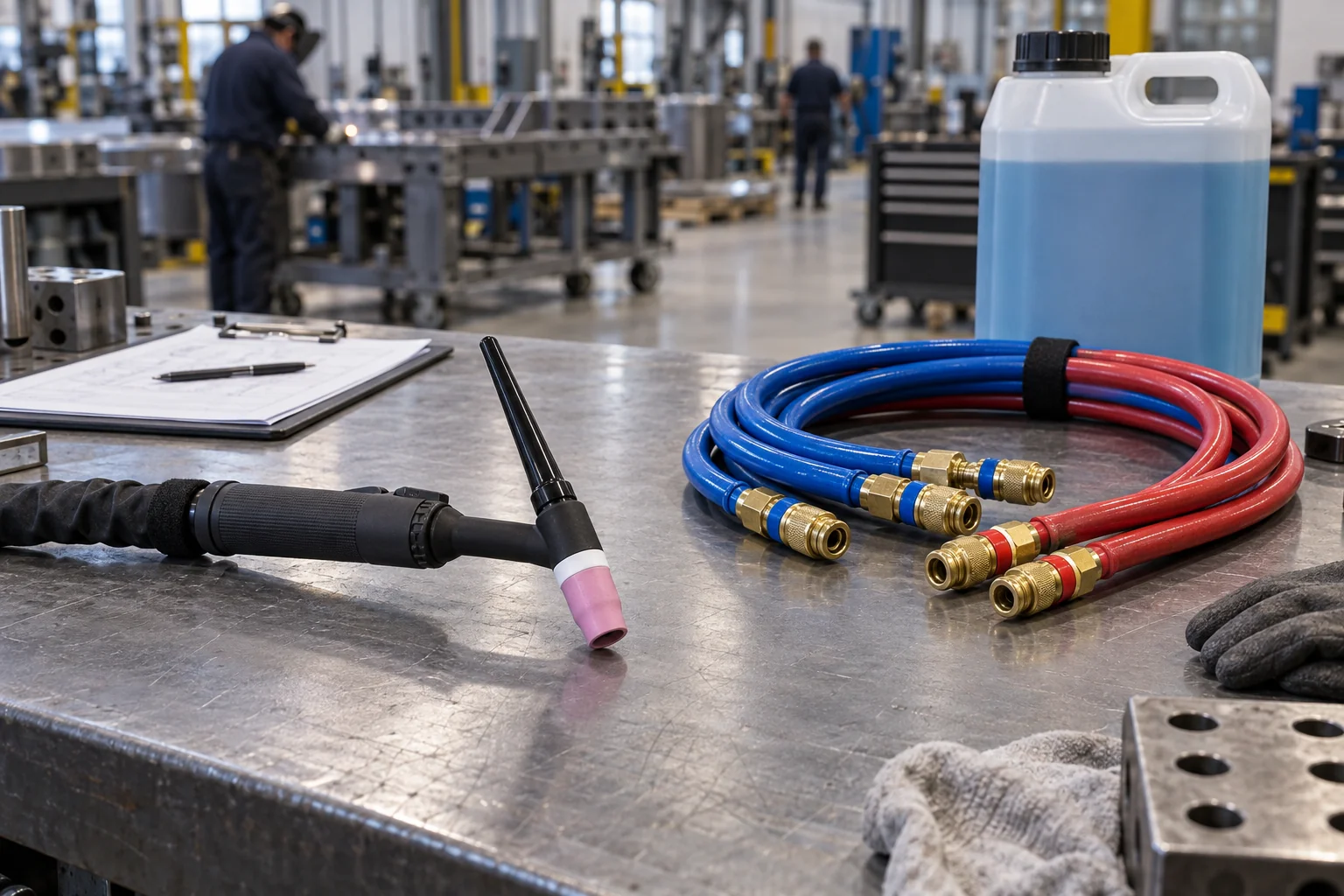
- Supply and return hoses, fittings and any adapters.
- Flow monitoring, alarm interface and machine response, if specified.
- Mounting hardware, manuals, first-fill requirements and initial spares.
Use one revision-controlled equipment schedule for the order. If the factory proposes a substitute torch or cooler after sample approval, assess the combination again. An unchanged welder model number does not mean the whole station is unchanged.
Match Water Cooling to the Real Production Load
Describe a shift, not just maximum amperage
Record typical and maximum welding current, AC or DC operation, arc-on periods, pauses, joint access, ambient conditions and cable routing. Include the work that creates the longest sustained demand, not only the easiest sample. A shop making occasional short welds has a different purchasing case from a cell repeating long seams throughout a shift.
Water cooling can make a compact torch practical for demanding work, but it adds hoses, coolant management and service requirements. Air-cooled equipment may remain appropriate for some portable or intermittent applications. Miller's water-cooled torch overview describes its own high-duty applications; use the selected torch's documentation to make your actual decision rather than treating a general amperage threshold as universal.
Keep each component's rating separate
The power source, torch and cooler each have operating limits. A higher-capacity cooler does not increase the inverter's rated output, and a higher-current inverter does not make a small torch suitable for continuous use. Ask the supplier to state the conditions attached to each rating and identify the limiting component for your proposed duty pattern.
For aluminum production, define the required AC capability before reviewing cooling accessories. Our AC TIG welder buying guide covers that separate process-selection discussion. Cooling selection should follow the documented welding requirement.
Compare Cooling Capacity, Flow and Pressure Correctly
Do not substitute tank size for cooling performance
A TIG welding water cooler specification should identify cooling capacity, test conditions, coolant type, available flow and permitted pressure. Tank volume describes storage, while heat rejection describes the cooler's ability to remove heat under stated conditions. Neither number alone demonstrates performance with the selected torch and hose assembly.
ABICOR BINZEL's CR cooling-unit data lists capacity separately from tank size and shows different capacity figures for different fluids. That is a useful example of why purchasing comparisons must retain the conditions behind a number. Those values describe the named BINZEL products and are not specifications for GWELD equipment.
| Quotation field | Evidence to request | Comparison trap |
|---|---|---|
| Cooling capacity | Rated heat rejection with fluid and temperature conditions | Comparing ratings measured under different conditions |
| Flow | Required torch flow and verified flow with the proposed circuit | Treating a pump's maximum flow as installed flow |
| Pressure | Compatible pressure range for the torch and hoses | Assuming higher pressure is always preferable |
| Reservoir | Usable fill level, access and maintenance instructions | Using tank volume as the sole sizing rule |
| Installation | Supply, ventilation clearance, hose length and mounting | Accepting a bench test with a different layout |
Ask for measured results on the proposed assembly or a documented engineering basis for it. State the intended ambient range and installed hose length in the RFQ. If the quotation contains only a nominal pump figure, request the missing system information before comparing that offer with a fully specified package.
Verify the Water-Cooled TIG Torch and Connections
Check the complete interface
A water-cooled TIG torch has more interfaces than its front-end consumables. The purchasing drawing should distinguish welding current, shielding gas, coolant supply, coolant return and trigger or remote-control connections. Connector appearance and hose color are identification aids; the manufacturer's connection drawing governs actual installation.
Miller's Coolmate accessories literature lists different adapters for different power-source connections. It illustrates why “water cooler compatible” does not establish that every torch plugs directly into every machine. Ask the factory to confirm the exact adapter, cable and cooler combination supplied under your purchase order.
Retain the torch-specific requirements
The torch documentation should identify relevant AC and DC ratings, duty conditions, hose length and required cooling conditions. ABICOR BINZEL's TIG torch catalog provides examples of model-specific cooling and rating information. Use the equivalent current document for the proposed torch; do not copy another brand's limits into your acceptance specification.
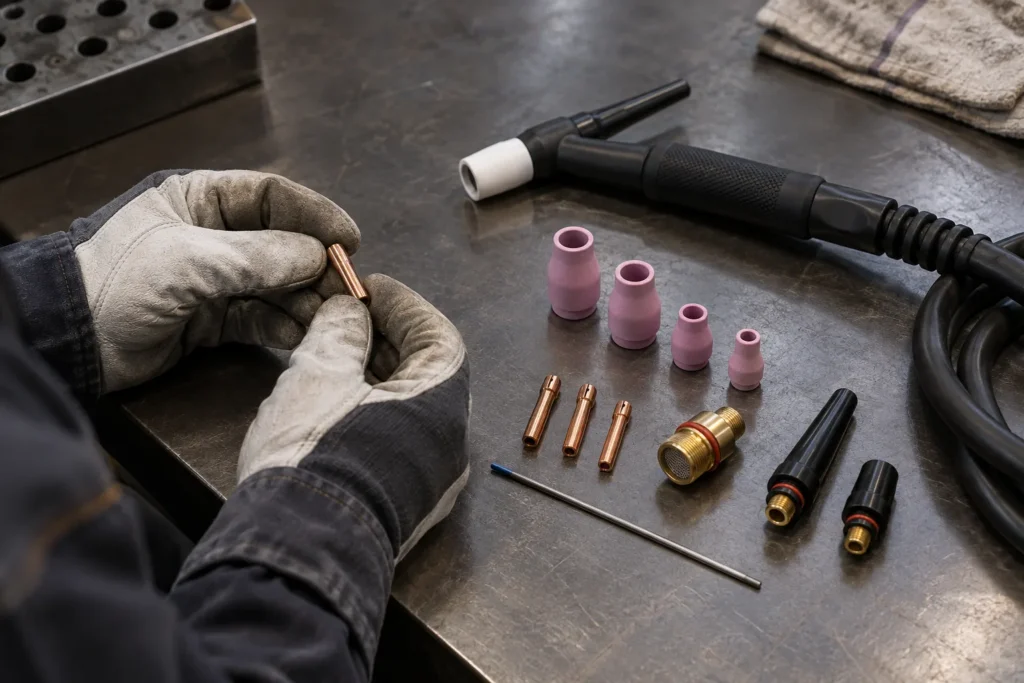
For stocking cups, collets and gas lenses, use the separate TIG torch parts identification guide. Approve the front-end parts and the cooled cable assembly as distinct groups, with clear reorder references for both.
Specify Coolant and a Practical Maintenance Plan
Request an approved fluid by specification
The word “water” in the product description is not a complete coolant instruction. Obtain the manufacturer's approved fluid specification, compatibility requirements, fill procedure and replacement schedule for the exact system. Ask whether the first fill is included and how the recommended fluid can be sourced in the destination market.
Coolant selection can depend on materials in the circuit and the welding system. The Miller Coolmate literature distinguishes products for different applications and includes restrictions involving aluminum in the coolant path and high frequency. Keep those restrictions product-specific. Do not assume a fluid approved for one brand, torch or cooling circuit is approved for another.
Make maintenance possible during normal operations
At the quotation stage, ask how technicians inspect coolant level, access filters, clean the heat exchanger, identify leaks and order seals or hoses. Require the factory's maintenance instructions and a list of consumables. A station that is difficult to inspect may encourage missed checks even if its headline cooling rating is adequate.
Define responsibility for routine inspection, fault reporting and releasing equipment back to service. Keep records of the installed fluid and replacement parts. Never use an editorial image or a generic online checklist as an installation manual. Follow the supplied instructions and have qualified personnel handle electrical, pressurized-circuit or other service work that the manual restricts.
Confirm Flow Protection and Control Integration
Ask what the system actually detects
A running pump or illuminated cooler switch does not by itself demonstrate that the welding control receives a valid cooling signal. Ask whether the package includes flow monitoring, temperature monitoring, alarms and an interface that affects welding operation. Have the supplier distinguish standard functions, optional components and functions that require external integration.
Miller's Continuum cooler page describes integrated flow and temperature detection for that specific platform. Use it as an example of clearly stated functionality, not evidence that every industrial cooler or GWELD configuration includes the same protection.
Turn claims into an acceptance item
Request a description of the monitored condition, alarm indication, machine response and reset procedure. For automated work, identify who supplies the wiring, control logic and commissioning support. A dry contact, an on-screen warning and an automatic welding inhibit are different deliverables; the quotation should say which one is included.
Have the supplier demonstrate protection through its approved test method during acceptance. Buyers should not improvise a blocked-flow test or deliberately run a torch without cooling. Record the demonstrated response and its limits, then retain the relevant wiring and operating documents with the equipment schedule.
Evaluate the Factory's Evidence and Order Controls
Request records for the proposed configuration
A factory presentation is most useful when it leads to records for the system being quoted. Ask for the current specification revision, bill of supplied components, inspection plan, sample serial numbers and a proposed test report. Review whether the same combination will be supplied in production, including torch, cooler, adapters and software options where relevant.
For a distributor, also establish packaging, labeling language, spare-parts identifiers and the handling of engineering changes. Decide who approves substitutions and how the factory communicates them. Keep approval records tied to actual part numbers so a later replacement order can be checked without relying on a photograph of an old sample.
Confirm commercial and market requirements separately
Give the supplier the destination market and required documentation list. Ask for documents that identify the actual models and configuration rather than accepting a generic certification statement as sufficient. Have the responsible purchasing or compliance team review the evidence against the project's requirements before release.
Warranty scope should identify the power source, cooler, torch and consumables separately, including exclusions, service procedure and freight responsibility. Request current written terms with the offer. For broader supplier assessment, the TIG manufacturer sourcing guide complements this system-level checklist.
Agree on a Representative Factory Acceptance Test
Write the test scope before the sample is built
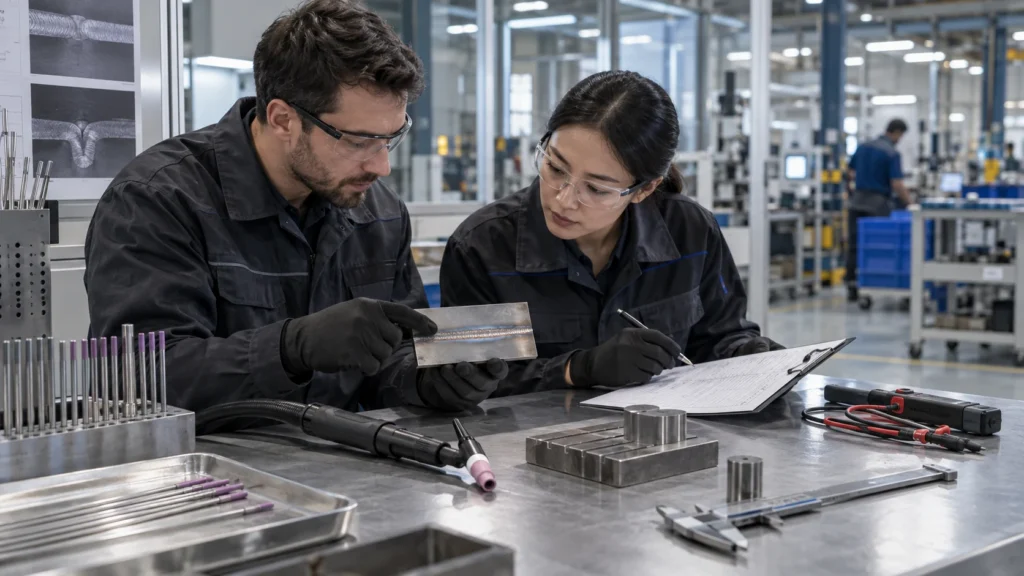
A useful acceptance plan defines the supplied configuration, test conditions, observations, required records and approval responsibility. Select representative materials, joints and welding procedures with the engineering team. Include the intended current range, operating pattern, ambient conditions and hose arrangement so the demonstration answers your actual production question.
A brief arc demonstration can confirm basic operation but may leave sustained thermal behavior, alarm integration and service access unresolved. Agree which checks belong at the factory and which must be completed after installation. Use manufacturer-approved methods and project-qualified personnel rather than inventing universal pass limits.
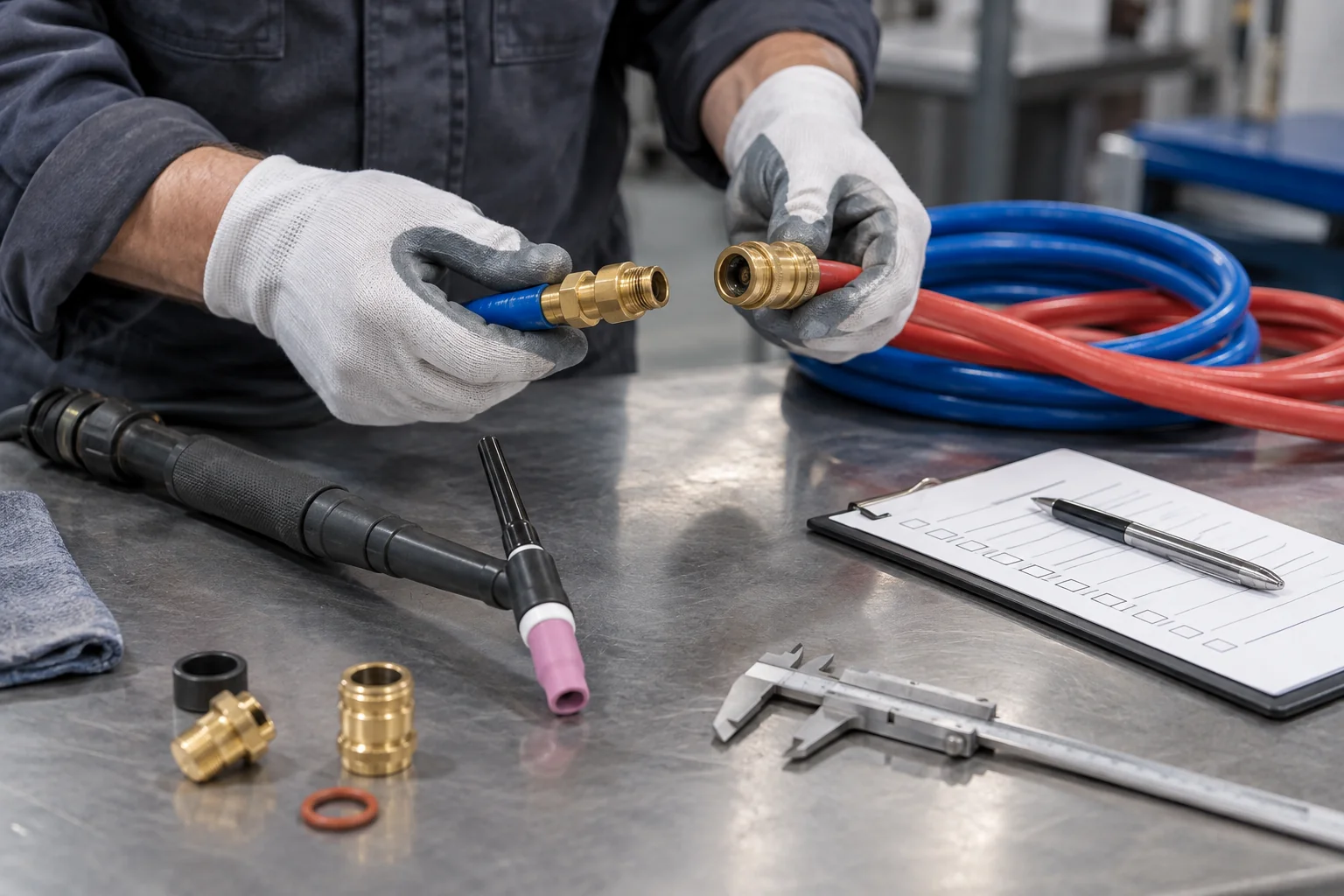
| Acceptance item | Record to retain | Approval question |
|---|---|---|
| Delivered configuration | Models, serial numbers, hose lengths and adapters | Does it match the approved order? |
| Cooling circuit | Fluid identification and documented flow/leak checks | Does it meet the selected equipment's requirements? |
| Representative operation | Procedure, current, timing and recorded observations | Does the station support the agreed work pattern? |
| Protection functions | Approved simulation method and observed response | Are the quoted alarms and interlocks demonstrated? |
| Weld acceptance | Inspection results against the agreed procedure | Do the sample welds meet project criteria? |
| Handover | Manuals, parts list, training and open-item record | Can the receiving team install and maintain the package? |
List deviations explicitly and assign corrective actions before shipment. Distinguish an approved concession from a failed test that remains open. Preserve the accepted sample configuration as the reference for later units, while recognizing that each production batch still needs its agreed inspection records.
Compare Lifecycle Cost and Spare-Parts Availability
Compare complete installed packages
Normalize quotations before comparing price. Include the cooler, torch, adapters, trolley, initial fluid, installation support, inspection work and delivery terms. Identify optional protection functions separately. This prevents a bare power-source offer from appearing cheaper than an installation-ready package when the scope is different.
Build the ownership comparison from your own production data. Use expected service hours, recorded consumable use, local labor rates and realistic downtime exposure. If reliable history is unavailable, label assumptions and compare a reasonable range. Avoid treating a supplier's unexplained percentage saving as an established result for your plant.
Order the spares that restore the station
Ask for availability and lead times for hoses, fittings, filters, seals, torch assemblies and serviceable cooler components. Confirm which items operators may replace and which need authorized service. Keep compatible part numbers and maintenance instructions together; visually similar fittings should not enter stock as approved substitutes without review.
For a multi-station fleet, record the common and model-specific parts before standardizing the purchase. A shared spare may reduce stock complexity, but only when compatibility is documented. Consider a small approved starter kit and a reorder plan based on actual usage rather than buying every catalog accessory with the first shipment.
Send GWELD a Complete Water-Cooled TIG RFQ
Give the team an application and a package scope
GWELD's published TIG 315/350P ACDC, TIG 400/500P ACDC and TIG 300/400/500 DC Pulse product pages identify water-cooler compatibility. Treat these as starting points for a configuration discussion. Ask the team to confirm the current model specification, selected torch, cooler and complete supplied connections in writing.
- Materials, thickness range, joint types and required welding modes.
- Typical current, arc-on pattern, shifts and ambient conditions.
- Site voltage and phase, installation space and cable reach.
- Manual or automated operation and required alarm integration.
- Quantity, destination, branding needs and planned delivery date.
- Sample acceptance criteria, required documents and initial spares.
Ask for an itemized answer
Request one schedule showing included components, optional items, operating limits, test evidence, lead time and current warranty terms. Explain whether you need a complete station, a cooler-compatible power source or an accessory upgrade for existing equipment. These are different offers and should be compared on their actual scope.
Use the GWELD technical inquiry team to submit the requirement. For heavy or repeated production work, describe the duty pattern and installation constraints first; the appropriate industrial TIG cooling system must be confirmed as a complete assembly.
Related Products

TIG 315/350P ACDC
A compact, air-cooled TIG/Stick inverter welder designed for AC and DC welding.
- Water Cooler compatible.
- Uses stronger and more durable material.
- Equipped with selected and reliable accessories to enhance the welder’s experience.
- Industrial level welder with a higher redundancy design increases reliability, extends service life, and enhances durability.

TIG 400/500P ACDC
A compact, air-cooled TIG/Stick inverter welder designed for AC and DC welding.
- Water Cooler compatible.
- Uses stronger and more durable material.
- Equipped with selected and reliable accessories to enhance the welder’s experience.
- Industrial level welder with a higher redundancy design increases reliability, extends service life, and enhances durability.

TIG 300/400/500 DC Pulse
A compact, air-cooled TIG/Stick inverter welder designed for AC and DC welding.
- Uses stronger and more durable material
- Water Cooler compatible.
- Equipped with selected and reliable accessories to enhance the welder’s experience.
- Industrial level welder with a higher redundancy design increases reliability, extends service life, and enhances durability.
Related Solutions

Heavy Fabrication
The ultimate TIG welder solution for heavy-duty industrial demands. Built with solid materials and thoughtful R&D, our machines offer the precise control required for high-integrity stainless steel joins and the reliable power needed for deep penetration in thick carbon steel. Experience professional performance in a balanced design engineered for the most demanding fabrication environments.

General Fabrication
The ultimate TIG welder solution for diverse fabrication needs. Built with solid materials and thoughtful R&D, our machines offer the precise control required for stainless steel and the reliable power for carbon steel. Experience professional performance in a balanced design engineered for the versatile fabricator.

Pipeline
The ultimate TIG welder solution engineered for critical pipe fabrication and field pipeline construction. Driven by thoughtful R&D and built with heavy-duty solid materials, our machines deliver the precise arc control required for flawless 5G/6G root passes on stainless steel and the reliable power for deep-penetration fill passes on carbon steel pipes. Achieve X-ray quality joints and maximum uptime with a balanced design built for the world’s most demanding energy and process piping projects. GWELL ensures your crew is always ready to go with professional performance that eliminates costly field rework.
Frequently Asked Questions
Conclusion
A dependable water-cooled welding machine factory should help turn your application into a documented, matched package. Compare the power source, torch, cooler, fluid and controls together, retain the conditions behind every rating, and approve the sample against an agreed test plan. Include maintenance access and replacement parts in the purchasing decision.
To discuss a GWELD proposal, send your material, welding duty pattern, site supply and required package scope. Request a written configuration and itemized quotation so engineering, purchasing and maintenance can evaluate the same system before the order is released.