AC TIG Welder: Aluminum Production and Buying Guide
Introduction
An AC TIG welder for aluminum production should be selected by its ability to reproduce an approved weld, not by maximum amperage alone. Fabrication managers, equipment distributors and OEM buyers need consistent arc control, usable output, compatible accessories and a support plan that remains practical after the first order.
This guide focuses on aluminum production decisions: how to specify AC controls, test representative joints, compare complete system costs and document acceptance. It does not provide a universal welding recipe or assume that every machine in a product family has identical capabilities. Start with the application, confirm the exact model and turn supplier promises into measurable checks.
For mixed-material procurement, use the broader AC/DC TIG fleet guide alongside this aluminum-focused checklist. GWELD buyers can then compare the TIG welder product range against their own production requirements.
What an AC TIG Welder Does for Aluminum Production
AC output is a process capability, not just an input-power label
In TIG welding, AC refers to alternating polarity at the welding output. It should not be confused with a machine receiving AC electricity from the factory supply. A power source powered by an AC outlet may still offer DC-only TIG output. Ask the supplier to identify the output processes explicitly before comparing prices.
AC is commonly chosen for aluminum because alternating polarity provides oxide-cleaning action while supporting heat delivery into the workpiece. AC balance and frequency are different controls: balance changes the polarity-time relationship, while frequency affects the arc characteristics. Neither replaces proper surface preparation, joint fit-up or a qualified welding procedure.
Define the production envelope before choosing equipment
The right AC TIG welder for aluminum depends on alloy, thickness, joint geometry, access, weld position and acceptance requirements. A thin enclosure, a heavy frame and a repair casting present different demands. Document these differences instead of standardizing on one attractive specification and expecting operators to compensate.
Create a shortlist of representative parts, including the easiest recurring joint and the most demanding approved joint. Record fixture design and the actual shift pattern. This gives engineering, purchasing and the supplier a shared definition of production readiness, reducing the chance that a successful showroom weld is mistaken for a complete acceptance test.

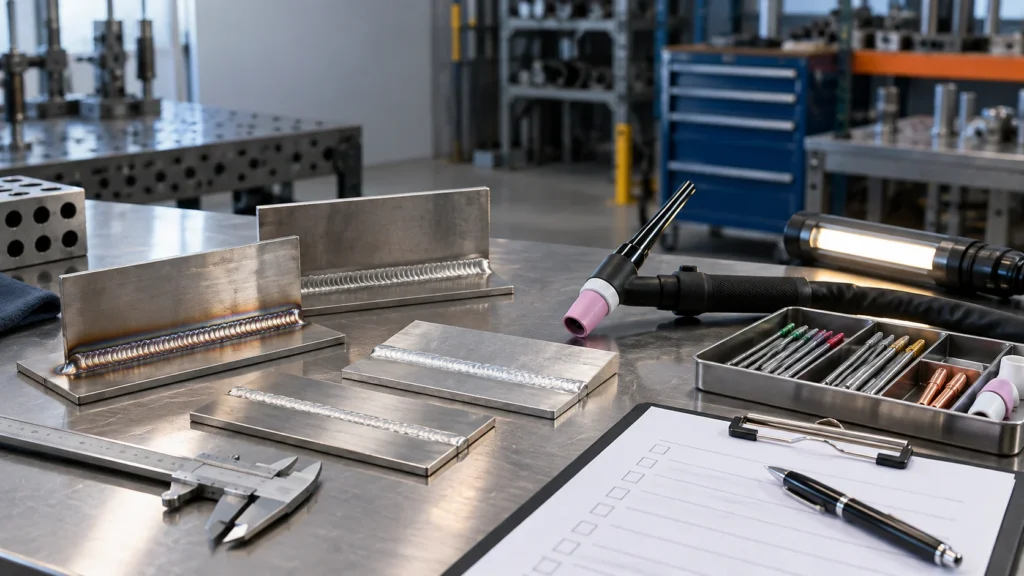
Illustrative aluminum TIG production scene; not a GWELD factory or product test photograph.
Specify AC Balance, Frequency and Pulse Without Guesswork
Check how the manufacturer defines balance
Manufacturers may express balance as electrode-negative time, electrode-positive time or a cleaning-oriented scale. Identical numerical settings are therefore not automatically equivalent between machines. Require the manual to state the definition and confirm it during the trial. Avoid copying a percentage from another brand without translating its meaning.
Ask the supplier to demonstrate the adjustment, explain the available range and identify any limits associated with current or waveform selection. Save the accepted setting using both its displayed value and its definition. That record is more useful for fleet standardization than a photograph of a control panel alone.
Separate output frequency from pulse frequency
AC output frequency governs polarity cycles; TIG pulse frequency governs the alternation between peak and background current. They are not interchangeable specification lines. If the application requires both, check whether they can operate together and whether the proposed model saves all required parameters.
Evaluate adjustment range, interface clarity, repeatability and the accepted weld result together. Additional waveform choices are valuable only when the production team can use and reproduce them. A long menu does not establish lower distortion, faster travel or less rework without an application-specific comparison.
Use manufacturer instructions as a control reference
A Miller owner manual describing AC controls illustrates why balance definitions and control availability must be checked. It is a reference for that machine, not a parameter prescription for GWELD equipment. Record the current manual revision supplied with your selected model.
For a control-level worked example and a reusable setup record, use our AC balance TIG welding setup and QC guide before transferring approved parameters between machines or shifts.
Convert Aluminum Applications Into a Procurement Matrix
Use a purchasing matrix to translate production needs into supplier questions. The following checks are a specification framework, not approved welding parameters or guaranteed thickness capacities.
| Production need | Capability to check | Acceptance evidence |
|---|---|---|
| Thin aluminum components | Low-current stability, starting and repeatable control | Representative starts, stops and completed samples |
| Long seams or repeated assemblies | Usable output, torch cooling and operator access | Trial following the planned welding and cooling sequence |
| Variable joint geometry | AC controls, remote current adjustment and fixture access | Approved samples from the demanding joint locations |
| Mixed aluminum and steel work | Required AC and DC processes on the exact model | Separate material-specific trial records |
| Multi-cell standardization | Parameter transfer, accessories and service documentation | Cross-machine repeatability and configuration records |
Include constraints that do not appear on the front panel
List available voltage and phase, installation space, cable route, working distance and the location of grinding operations. Identify who supplies the torch, cooler, regulator, remote control and consumables. A technically suitable power source can still create a poor installation when those responsibilities remain unclear.
For a distributor, add the destination market, customer training needs and service arrangement. For an OEM buyer, add branding, documentation language and revision control. These commercial requirements should be visible in the same enquiry package, so the quotation describes a deliverable system rather than an isolated machine.
Size Usable Output and Cooling for the Real Shift Pattern
Read duty cycle together with its test conditions
Maximum current and continuous usable current are different purchasing considerations. A duty-cycle figure needs its rated current, voltage, ambient temperature, reference period, cooling arrangement and applicable test basis. Compare like-for-like conditions; do not convert a rating at one temperature into a different-temperature promise without evidence.
If the production environment requires performance at 40°C, request the relevant model-specific report. A 100% duty-cycle claim must identify the current at which it applies. Do not interpret it as unlimited operation at every setting or as proof that the torch, cooler and installation have the same capacity.
Evaluate the complete thermal chain
Review the torch rating, hose condition, cooler compatibility, coolant requirements and protection behavior. Confirm which accessories are included and which are optional. Arrange the trial around the actual production sequence rather than deliberately operating outside the manufacturer's limits.
Record thermal interruptions, restart behavior and the practical time needed to return to production. If capacity is insufficient, reconsider the system specification, fixture cycle or work allocation with engineering. Removing a protective function is not an acceptable productivity solution.
Keep enclosure claims model-specific
An IP rating does not, by itself, prove suitability for every dusty, wet or outdoor condition. Request the exact protection rating and installation instructions. If isolated airflow, a particular DSP architecture or component transparency matters, ask for approved documentation rather than assuming that a feature applies to every GWELD machine.
Match the Torch, Gas, Tungsten and Filler as One System
Accessories can determine practical production performance
The power source cannot compensate for unsuitable consumables, poor gas coverage or contamination. Standardize the torch connection, cable length, remote interface, cup arrangement, tungsten preparation and approved filler before comparing machines. Use the same controlled setup when a fair comparison requires it.
Confirm shielding-gas requirements through the qualified procedure and equipment instructions. Check leaks and delivery consistency rather than increasing flow without diagnosis. Gas settings, tungsten selection and filler classification should be recorded as part of the procedure, not treated as incidental purchasing details.
Build a repeatable consumables package
Define which parts are interchangeable across cells and which are specific to a torch family. Keep spare quantities aligned with service lead time and observed consumption. Mark the approved part numbers so a replacement order does not silently change the accepted configuration.
For material selection and handling discussions, review the TIG welding wire procurement guide and the TIG tungsten preparation guide. Confirm the final combination with the welding engineer and project requirements rather than using either article as qualification approval.
Run a Representative AC TIG Welder Acceptance Trial
Agree the test before the sample is welded
Select representative base material, thickness, filler, joint preparation and fixtures. Identify the applicable procedure, inspection method and acceptance criteria before testing. A visually attractive bead is not sufficient evidence for a joint whose acceptance requires additional inspection or mechanical testing.
- Document the exact machine, firmware where relevant, accessories and input supply.
- Check controls, starting, remote operation and parameter storage against the enquiry.
- Weld the agreed coupons or parts using the approved procedure and qualified personnel.
- Record settings, welding sequence, interruptions and consumable configuration.
- Inspect using the agreed method and retain traceable results.
- Repeat selected work after a restart or operator change to assess reproducibility.
Separate observations from conclusions
For example, a production team could trial a thin enclosure joint and a longer frame joint on the same shortlisted system. This is an illustrative planning scenario, not a GWELD customer case. The purpose is to expose different operating demands and decide what additional evidence is needed.
If a defect appears, investigate preparation, fit-up, gas coverage, procedure and equipment systematically. Do not attribute every result to the power source or claim an improvement percentage from one sample. Retain failed samples and corrective actions alongside accepted results so the final decision remains auditable.
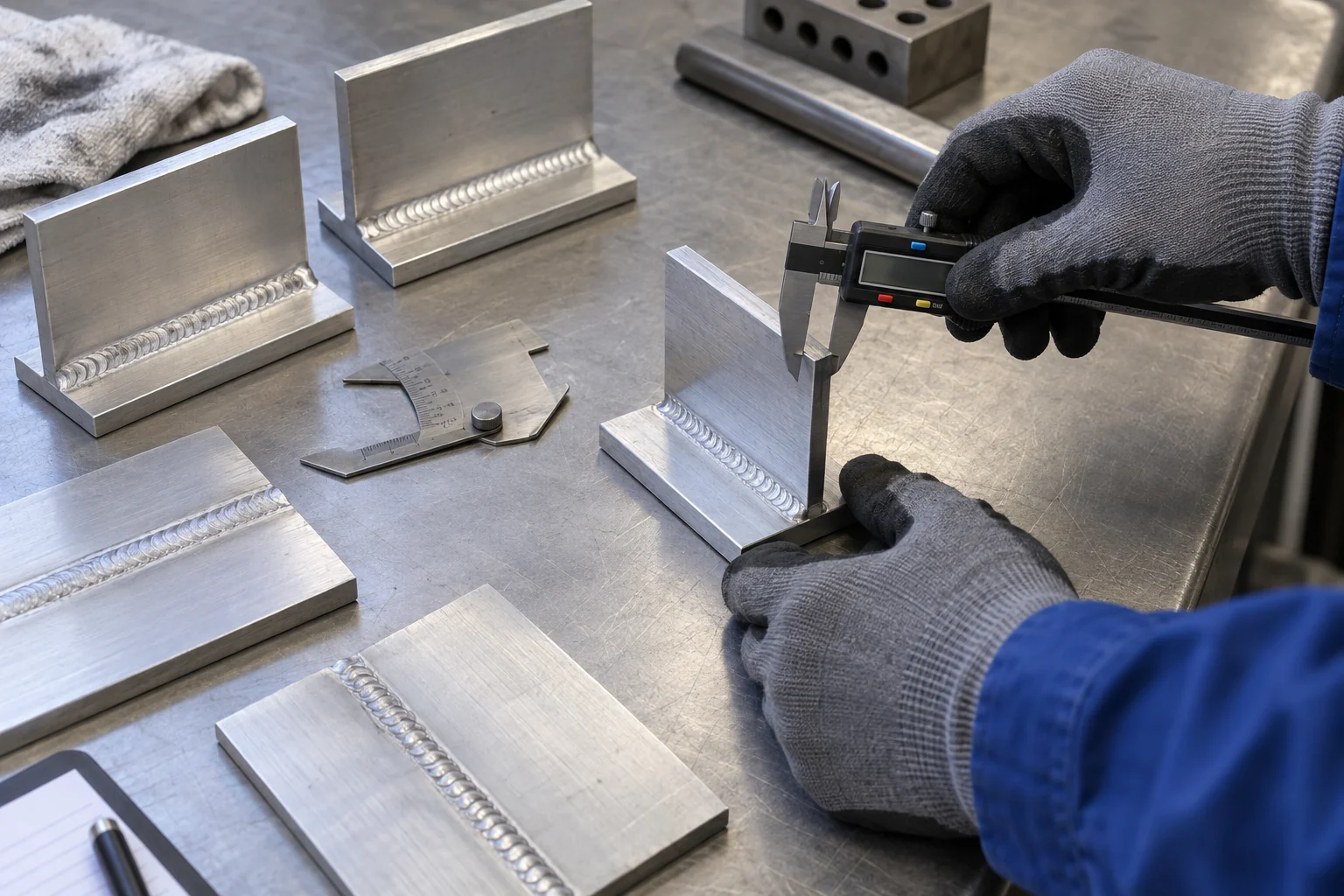
Illustrative acceptance inspection; actual approval requires the agreed procedure and inspection method.
Compare an AC TIG Welder by Accepted-Weld Cost
Replace a price-only comparison with a defined cost model
Searches such as cheap AC TIG welder or AC TIG welder cheap usually start with purchase price. For a production buyer, the relevant question is whether the complete system delivers acceptable work at a sustainable cost. Include accessories, installation, training, maintenance, consumables and the consequences of interruptions.
A useful internal metric is total attributable production cost divided by the number of accepted parts or approved weld units. Define the period and included costs consistently. Keep assumptions visible, distinguish estimated costs from measured costs and avoid presenting a hypothetical calculation as verified savings.
| Cost category | Question for the quotation | What purchasing should retain |
|---|---|---|
| Complete equipment package | Are torch, cooler, cables and remote included? | Configuration and itemized scope |
| Installation and commissioning | Who handles electrical installation and training? | Responsibilities and acceptance milestones |
| Consumables and service | Which parts are stocked and what are the lead times? | Approved parts list and service route |
| Quality and downtime | What evidence supports repeatability and recovery? | Trial records and tracked production observations |
| Warranty and freight | Which written terms apply to this model and market? | Final agreed terms and delivery basis |
Use the same requirements for every supplier
When comparing a Miller AC TIG welder with a GWELD proposal or another supplier, use current manuals and matched configurations. Do not assume that a brand name proves a particular duty cycle, or that factory sourcing automatically produces lower lifecycle cost. Evaluate evidence and support commitments against the same acceptance plan.
Review GWELD AC TIG Options and Supplier Evidence
Shortlist product families, then verify the exact model
GWELD's catalog includes the TIG 180/200/225P ACDC, TIG 315/350P ACDC and TIG 400/500P ACDC families. They provide starting points for an aluminum-focused enquiry; family names are not a substitute for the final datasheet and configuration. Ask GWELD to match the proposed model to your application and installation requirements.
The published TIG 315/350P ACDC product page describes AC/DC operation and water-cooler compatibility. Confirm the exact configuration, rating conditions and applicable written warranty terms with GWELD before approval. Product-family descriptions are a starting point, not a substitute for the agreed model-specific specification.
Request evidence proportional to the production risk
- Exact model datasheet, operating manual and accessory compatibility details.
- Duty-cycle evidence with the relevant current and ambient conditions.
- Destination-market compliance documents for the proposed configuration.
- Sample-testing scope, inspection records and acceptance responsibilities.
- Parts availability, troubleshooting route and written warranty terms.
- OEM branding, documentation and change-control arrangements when applicable.
For automated integration, specify the required signals and data points. Confirm whether digital I/O, Profinet, EtherCAT or Modbus TCP is available directly, through an option or through a gateway; do not presume native support. Likewise, confirm any Open-BOM disclosure scope and component-change notification in writing.
Prepare an Aluminum Welding RFQ That Produces Comparable Quotes
Send the application, not only a requested amperage
A useful RFQ includes alloy grades, thickness range, joint drawings, welding positions, production quantity, duty pattern and inspection requirements. Add available supply voltage and phase, working distance and the proposed torch or cooling arrangement. Identify sample requirements and the delivery market.
For OEM and wholesale projects, include the intended customer segment, anticipated order mix, branding scope and service expectations. State which details are mandatory and which are open for engineering recommendations. This helps suppliers propose alternatives without quietly removing an essential requirement.
Close specification gaps before ordering
Review the quotation against the RFQ line by line. Resolve exceptions, optional items, software features and documentation gaps before the purchase decision. Assign owners for trial approval, installation readiness and final acceptance. Keep the approved configuration with the order so later substitutions can be evaluated rather than overlooked.
Use the GWELD OEM and wholesale sourcing guide for supplier-level review, then send GWELD your aluminum welding RFQ for an application-specific discussion. A clear enquiry reduces revision cycles and makes both technical and commercial comparison more reliable.
Keep the Accepted Configuration Stable After Delivery
Turn the trial record into a practical handover package
After approval, retain the selected model, serial records, accessory part numbers, manual revision and accepted parameter settings. Assign responsibility for operator instruction and consumable replacement. Keep the agreed procedure available at the work cell and distinguish protected production settings from experimental settings used during development.
For repeat orders, ask whether hardware, firmware, controls or approved accessories have changed. Evaluate any change against the original acceptance plan before treating a replacement as equivalent. This prevents a successful first delivery from becoming an undocumented series of different configurations.
Measure performance using the same definitions
Review accepted output, interruptions, rework and parts consumption at a defined interval. Record the reason for downtime rather than combining equipment faults, material shortages and fixture delays into one number. Use those observations to adjust support stock, training or the next RFQ. Do not claim a machine-related productivity gain unless the comparison supports that conclusion.
Related Products

TIG 180/200/225P ACDC
A compact, air-cooled TIG/Stick inverter welder designed for AC and DC welding.
- Designed for aluminum welding, with precise control for thin and delicate materials.
- Advanced pulse technology helps reduce heat input and improve weld appearance.
- Built with durable components and a rugged structure for long-term reliability.

TIG 315/350P ACDC
A compact, air-cooled TIG/Stick inverter welder designed for AC and DC welding.
- Water Cooler compatible.
- Uses stronger and more durable material.
- Equipped with selected and reliable accessories to enhance the welder’s experience.
- Industrial level welder with a higher redundancy design increases reliability, extends service life, and enhances durability.

TIG 400/500P ACDC
A compact, air-cooled TIG/Stick inverter welder designed for AC and DC welding.
- Water Cooler compatible.
- Uses stronger and more durable material.
- Equipped with selected and reliable accessories to enhance the welder’s experience.
- Industrial level welder with a higher redundancy design increases reliability, extends service life, and enhances durability.
Related Solutions

Automotive
From thin-gauge body panels to heavy-duty chassis components, GWELL provides the precise arc control and reliable performance required for the modern automotive industry. Our Pro-tier technology ensures every joint meets the highest safety and aesthetic standards.

General Fabrication
The ultimate TIG welder solution for diverse fabrication needs. Built with solid materials and thoughtful R&D, our machines offer the precise control required for stainless steel and the reliable power for carbon steel. Experience professional performance in a balanced design engineered for the versatile fabricator.

Heavy Fabrication
The ultimate TIG welder solution for heavy-duty industrial demands. Built with solid materials and thoughtful R&D, our machines offer the precise control required for high-integrity stainless steel joins and the reliable power needed for deep penetration in thick carbon steel. Experience professional performance in a balanced design engineered for the most demanding fabrication environments.
Frequently Asked Questions
Conclusion
The best-fit AC TIG welder is the system that meets the approved aluminum application, reproduces acceptable work and can be supported through its operating life. Compare AC control definitions, usable output, accessories, acceptance evidence and complete cost together. Keep machine-specific ratings separate from general process guidance.
Before approving a fleet or OEM order, complete a representative trial and close the documented specification gaps. Share alloy, thickness, joint geometry, duty pattern, installation details and destination market with GWELD. Request an application-specific AC TIG welding equipment quotation with a clearly defined configuration and acceptance plan.