Weld Cleaning Machine: Stainless Steel Buying Guide
Introduction
Choosing a weld cleaning machine is a production-quality decision, not simply a way to make stainless steel welds look brighter. Buyers need to match the cleaning method to the alloy, weld condition, surface finish, access constraints and documented acceptance requirements. A fast demonstration on one flat coupon is not enough to approve a machine for a complete fabrication line.
This guide explains how industrial purchasers can compare equipment, distinguish cleaning from passivation, plan meaningful sample trials and prepare an actionable request for quotation. The focus is repeatable acceptance and total finishing cost, with model-specific capabilities confirmed before purchase.
What Does a Weld Cleaning Machine Do?
An electrochemical weld cleaning machine uses a controlled electrical process, a compatible working tool and a specified electrolyte to treat an accessible welded surface. Depending on the equipment and qualified procedure, the intended work may include removing welding discoloration or supporting a specified surface-treatment process. Cleaning, polishing and marking are separate functions; do not assume every unit provides all three.
Start with the finished-part requirement
Define what the customer will accept before comparing brochures. A decorative stainless enclosure, a process-pipe assembly and a structural bracket can have different appearance, cleanliness and documentation needs. A machine that meets one requirement may be unsuitable for another without a different tool or procedure.
- Identify the stainless grade, thickness, joint geometry and initial finish.
- Describe the weld discoloration, contamination and access limitations.
- State whether the requirement concerns appearance, contaminant removal, passivation verification or several of these.
- Ask the supplier to identify the exact machine, tool, liquid and procedure proposed.
Use the GWELD weld cleaning equipment category as a starting point for an equipment discussion. Request a current model-specific specification and sample evaluation; do not treat a category description as approval of your production process.
Heat Tint Removal Is Not the Same as Passivation
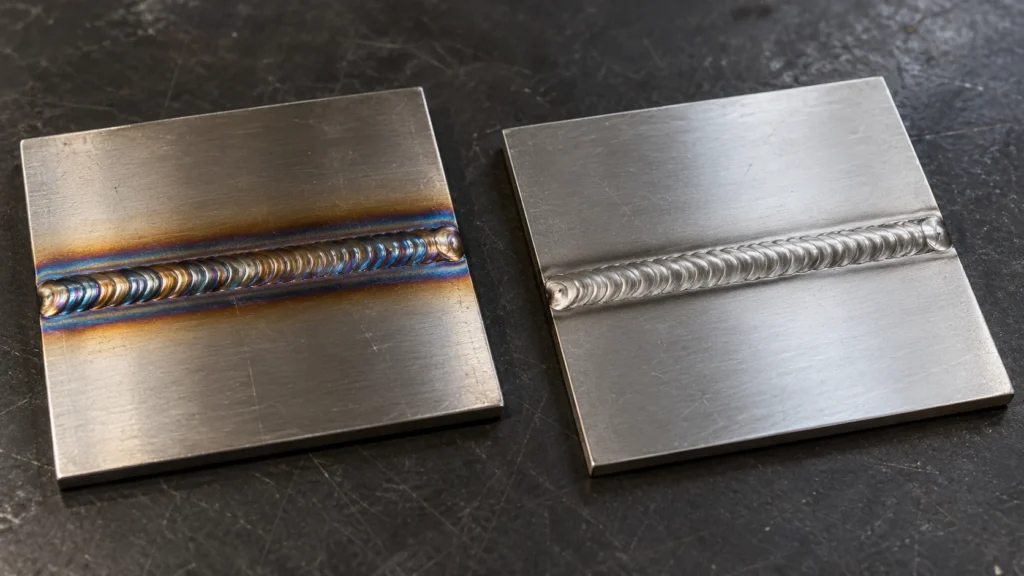
Welding heat tint is associated with surface oxidation and can impair corrosion performance. TWI's explanation of stainless steel heat tint describes why both scale and the affected surface layer matter. Removing visible color alone does not establish that a fabricated part meets its service requirements.
Define the word passivation in the purchase specification
The term weld passivation machine is widely used in equipment searches, but the label does not define an acceptance test. Ask what treatment is being offered, what condition must exist before treatment, and how the completed surface will be evaluated. A photograph can document appearance; it cannot replace the agreed acceptance evidence.
For projects that reference standards, ASTM A380/A380M addresses cleaning and related surface-treatment practices, while ASTM A967/A967M covers chemical passivation treatments and alternative verification tests. Confirm the contractually applicable edition, selected treatment and test with the responsible quality specialist. A standards reference is not a machine certification.
Keep appearance criteria and passivation criteria as separate lines in the trial record. This prevents a successful cosmetic demonstration from being mistaken for complete technical acceptance. If a customer's specification requires additional qualification, complete that work before releasing production.
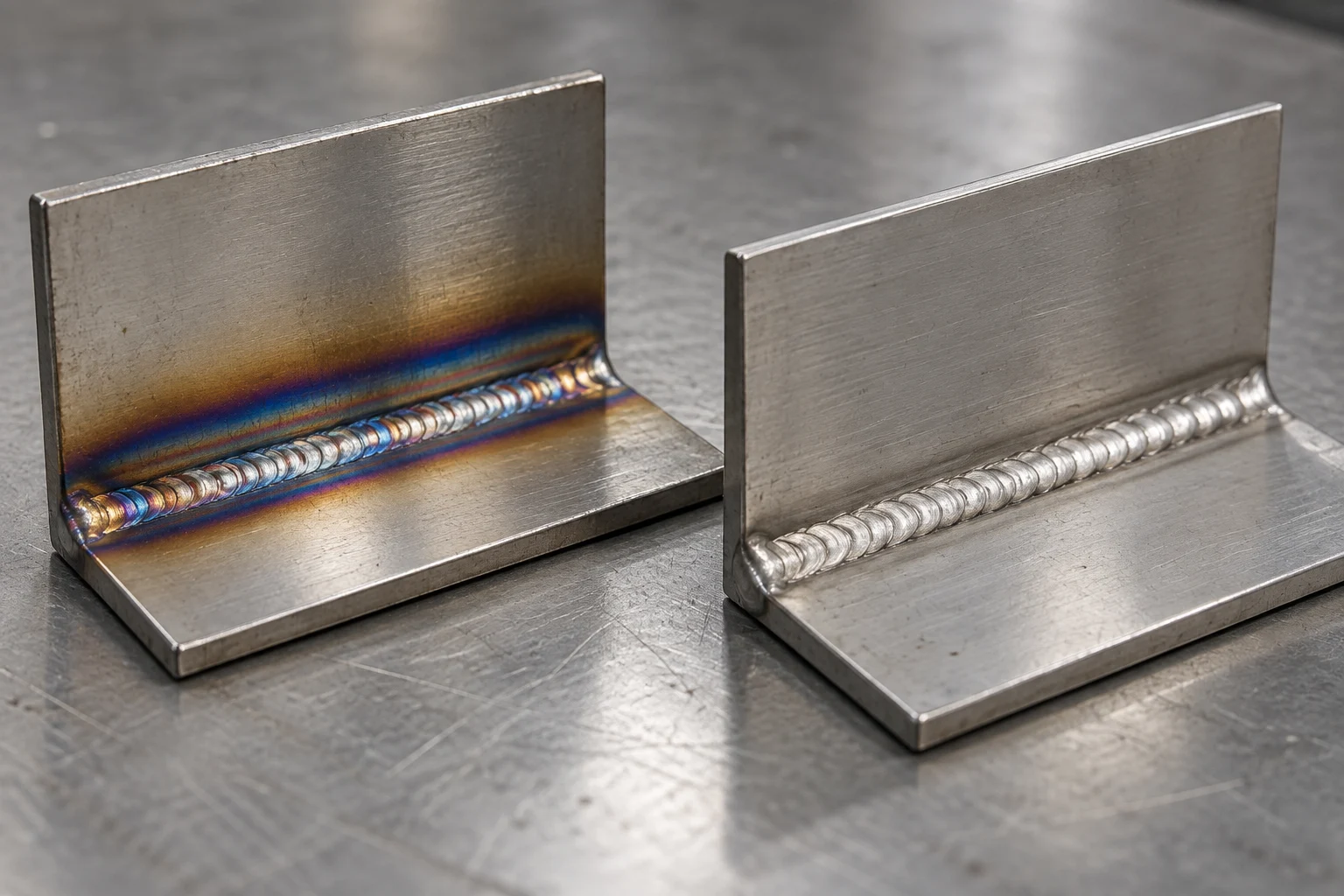
AI-generated illustrative surface comparison, not a documented machine test or proof of passivation.
Compare Cleaning Methods Before Choosing Equipment
There is no universally best finishing method for every stainless assembly. Compare the process routes that your engineering and safety teams approve, then test the short list on representative parts. The following table is a purchasing framework, not an operating procedure.
| Process route | Potential fit | Buyer verification |
|---|---|---|
| Electrochemical weld cleaning | Localized treatment of accessible seams | Tool reach, finish consistency, consumables, rinse requirements and acceptance evidence |
| Mechanical finishing | Surface blending or a specified abrasive finish | Geometry changes, finish direction, dedicated tooling and contamination controls |
| Chemical pickling | A qualified route for oxide removal on suitable parts | Material compatibility, competent processing, safety controls and waste handling |
| Specified passivation treatment | A defined cleanliness/passivation requirement | Required pretreatment, applicable procedure and agreed verification tests |
Compare complete workflows
Include part handling, preparation, treatment, rinsing where required, drying, inspection and any rework in the timing study. A method that appears quicker at the weld can still create a bottleneck at the wash station. Likewise, a compact machine may need more operator time when complex assemblies require frequent repositioning.
Do not equate reduced manual effort with zero chemical risk or zero waste. Each candidate process needs its own assessment. Let the quality team approve the finished surface, the safety team approve the work method, and purchasing compare the commercial package only after these conditions are clear.
Build a Stainless Steel Application Profile
Record the parts the machine will actually see
A useful application profile includes more than the thickest material in the factory. Group jobs by alloy, joint shape, surface finish and access. Record typical seam length per part, batch size, daily workload and the proportion of difficult corners. Include parts that previously caused staining, inconsistent appearance or finishing delays.
For a stainless steel passivation machine inquiry, explain whether the machine will serve an individual bench, a shared finishing area or several production cells. State how parts move to the station and whether treatment must happen before final assembly. Restricted access after assembly can invalidate an otherwise successful coupon trial.
- Provide photographs and drawings with the treatment area clearly identified.
- Include an ordinary production sample and a difficult but acceptable weld sample.
- Describe the required finish using an agreed reference, not only words such as shiny or clean.
- List available electrical supply, work area, storage and rinsing arrangements.
- Identify who approves the surface and what records must accompany delivery.
Keep upstream welding conditions reasonably consistent during the evaluation. If the weld condition changes substantially between suppliers' demonstrations, the resulting speed and finish comparison is not fair. Record the starting condition alongside each trial outcome.
Seven Checks for Weld Cleaning Machine Selection
1. Document the usable output
Ask for rated input requirements, operating modes, output adjustment and permitted working cycle in the proposed application. A headline amperage figure does not establish the rate of accepted finished parts. Have the supplier explain limits, protection behavior and any required cooling or recovery period.
2. Test access and operator handling
Try the brush or working tool on inside corners, tube transitions and obstructed seams. Check cable reach, connector security, grip comfort and whether the operator can see the treatment area. A flat demonstration panel does not reveal these practical constraints.
3. Check consumable compatibility
Request part numbers for the working tools, sleeves, leads and approved liquids. Confirm which combinations are permitted. Do not assume that a brush with a matching thread, or a liquid sold for another brand, is interchangeable.
4. Protect the specified finish
Include satin, brushed or polished reference samples where relevant. Agree the permitted change in texture and appearance before the trial. If polishing is required, confirm that the selected equipment actually supports the proposed polishing process.
5. Review service access
Ask how wear parts are replaced, what routine checks are required and who performs repairs. Confirm availability, lead time and warranty exclusions for the exact configuration. Separate consumable wear from equipment defects in the quotation.
6. Assess documentation and training
Request an operating manual, applicable safety data sheets and a training scope. Confirm the language and revision of each document. The handover should explain authorized configurations, maintenance boundaries and escalation when an unexpected finish appears.
7. Confirm destination requirements
For imported equipment, identify the destination voltage, plug, labeling and documentation requirements. Obtain evidence for the specific model and destination rather than relying on generic certification logos. Purchasing should record unresolved items before approving shipment.
Plan a Representative Supplier Acceptance Trial
A well-designed trial makes competing proposals easier to compare. Send the same drawing, acceptance checklist and sample conditions to each shortlisted supplier. Identify whether the trial is a feasibility demonstration or a formal contractual acceptance activity; the two are not interchangeable.
Use ordinary and challenging samples
Include the most common production weld and at least one difficult geometry from the intended workload. Keep a labeled untreated reference. Ask the supplier to identify the equipment configuration, consumable condition and operator instructions used. Photographs should show the same part and lighting before and after, without hiding unfavorable areas.
| Trial item | What to record | Why it matters |
|---|---|---|
| Starting sample | Alloy, finish, joint and discoloration | Makes comparisons repeatable |
| Equipment setup | Model, tools, approved liquid and procedure reference | Defines what is being purchased |
| Full cycle time | Preparation through inspection, including interruptions | Prevents misleading speed claims |
| Consumable use | Measured liquid and tool use during the trial | Supports operating-cost estimates |
| Acceptance result | Appearance plus the agreed technical checks | Separates cosmetic and functional approval |
| Exceptions | Rework, inaccessible areas and operator comments | Shows limitations before deployment |
Do not approve a production rate from a short edited video. Ask for the complete trial sequence and record any stoppages. Where important, repeat the test with a second trained operator to identify whether the outcome depends on a particular demonstration technique.
After installation, confirm that the agreed configuration performs under actual site conditions. Changes in sample condition, consumables or handling should trigger review rather than an assumption that the original approval covers every subsequent job.
Verify the Surface Instead of Relying on Shine
Agree the inspection plan before ordering
A practical inspection plan states the part identity, treatment area, acceptance criteria, inspection method, sampling rule, responsible person and retained records. Define what happens when a sample fails. Without these decisions, supplier and buyer can disagree even when looking at the same finished part.
Visual examination helps document discoloration, residues and finish consistency, but it has limits. Where passivation verification is specified, the quality team should select the applicable test and interpret its result within the project requirements. Do not use a magnified photograph or a bright surface as proof of corrosion resistance.
Keep records linked to production
Connect the treatment record to the relevant part or batch. Record the approved procedure revision, operator, equipment identity and inspection outcome. If a consumable or setting changes, retain enough information to understand whether the change affects the established process.
For critical-service or hygienic equipment, agree requirements directly with the responsible engineer or customer. This buying guide does not qualify a surface-treatment procedure or replace a licensed standard. A machine supplier can provide equipment information, but contractual acceptance remains a defined responsibility between the relevant parties.
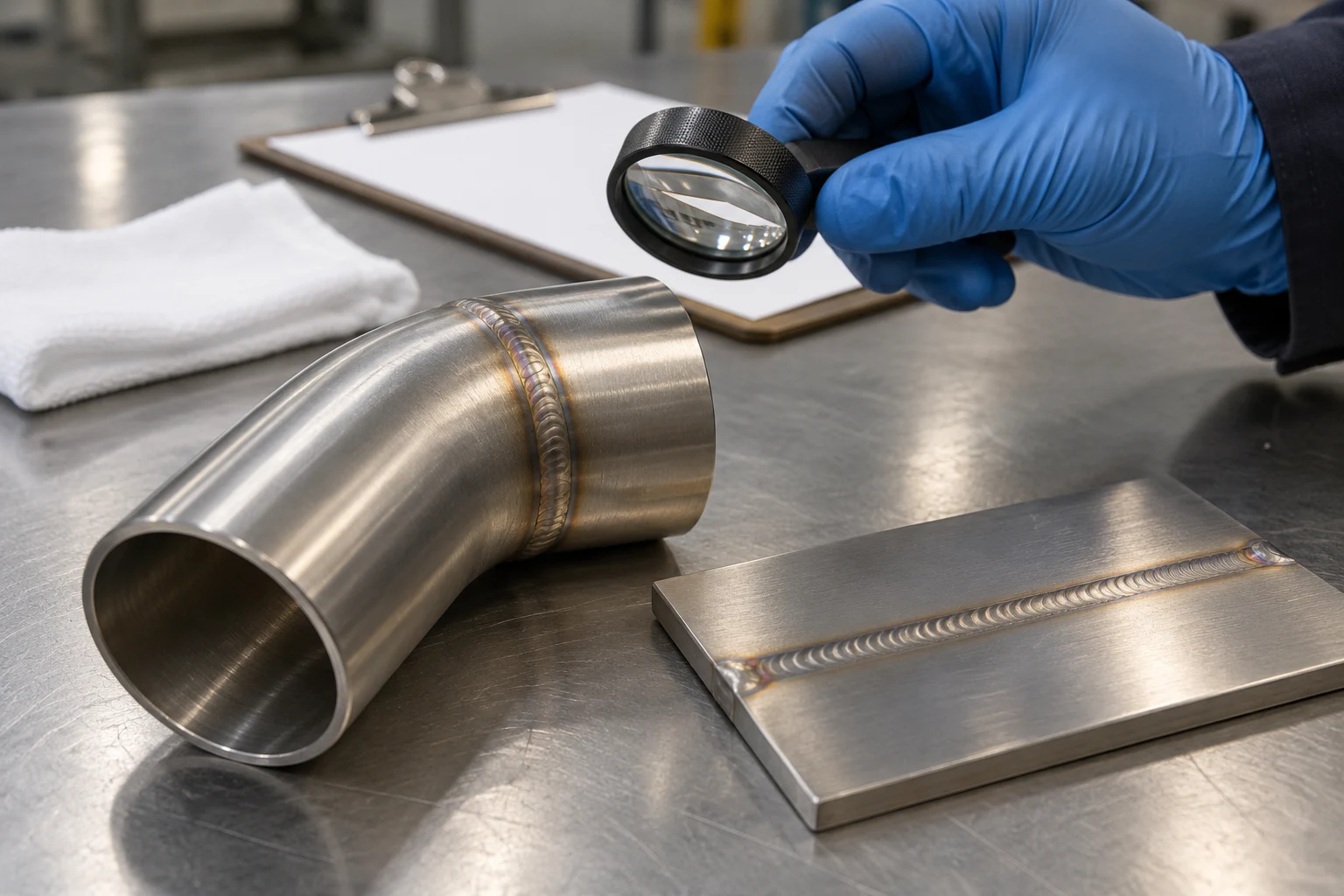
AI-generated illustration: visual inspection does not replace the agreed passivation verification tests.
Plan Chemical Handling, Rinsing and Waste Controls
An electric weld cleaning machine is still part of a chemical and electrical work system. Obtain current safety data sheets for the actual liquids and have competent personnel assess the complete operation. Avoid claims that a process is harmless simply because it uses a relatively mild formulation.
- Confirm the required personal protection, ventilation and emergency arrangements from the assessed procedure.
- Provide suitable storage, labeling and segregation for liquids and used consumables.
- Plan rinsing or neutralization only as specified by the approved process and manufacturer instructions.
- Keep treatment liquids away from unsuitable electrical components and incompatible materials.
- Arrange collection and disposal of residues and rinse waste under the applicable local requirements.
Include these provisions in the installation budget and station layout. An inexpensive machine can be a poor purchasing decision if the proposed location cannot support safe handling or proper finishing. Do not improvise liquid mixtures or substitute household products for specified consumables.
Training should cover routine operation and stop-work conditions. An unfamiliar odor, damaged lead, unexpected surface attack or inconsistent result should lead to review by the responsible person, not simply a higher setting or longer treatment.
Calculate Cost per Accepted Finished Part
The useful commercial comparison is cost per accepted part, not machine price alone. Build the calculation around your own trial measurements and workload. Include operator time, consumables, utilities, handling, inspection, waste management, maintenance and rework, together with an appropriate allocation of equipment cost.
Use a transparent comparison model
Cost per accepted part = total attributable finishing cost ÷ number of parts that pass the agreed checks. Keep assumptions visible. If two machines finish different numbers of acceptable parts, dividing only by total attempted parts hides the impact of rejects.
For a first estimate, separate fixed and variable costs. Purchase, installation and training are generally planned costs; consumables and processing labor depend on the workload. Model more than one production volume so that a quiet month does not make the investment look identical to a full-capacity month.
Ask suppliers to explain brush-life and processing-speed claims in terms of the tested joint, finish, operator and acceptance condition. Treat untested headline savings as hypotheses. Record consumables issued and accepted output during a controlled production trial before projecting annual savings.
Finally, include supply continuity. A low-cost consumable is not economical if its long delivery time repeatedly stops the finishing station. Confirm reorder quantities, local availability and a workable spare-parts plan.
Connect Post-Weld Cleaning with Upstream TIG Control
Finishing should not become a substitute for stable welding. Review shielding, joint preparation, operator consistency and the documented welding procedure alongside cleaning requirements. Reducing avoidable variation upstream makes post-weld trials more representative and cost planning more reliable.
For related process planning, see the stainless steel TIG welding guide and TIG shielding-gas and flow guide. Use qualified welding procedures and application-specific review rather than copying settings from an unrelated job.
Match the whole workstation
A new welding power source and a cleaning station perform different jobs, but purchasing them independently can create handling and scheduling gaps. Estimate how many assemblies move between the stations and identify the slower operation. Consider access for inspection before the next assembly stage closes off the weld.
If the upstream equipment also needs evaluation, the stainless steel welding machine buying guide provides a separate procurement framework. Keep welding-machine specifications distinct from weld-cleaning-machine capabilities; one does not establish the other.
Prepare an RFQ That Can Be Quoted Accurately
An actionable request for quotation gives the supplier enough information to propose a defined package, while keeping unresolved performance requirements visible. Send the same brief to each candidate so that the comparison covers equivalent equipment and support.
- Application: alloy grades, joints, finishes, part dimensions and photographs.
- Workload: typical batch size, seam length, shifts and expected expansion.
- Acceptance: appearance references, applicable project specifications and trial plan.
- Site: destination, electrical supply, workspace and handling arrangements.
- Package: equipment, approved consumables, starter quantities, spares and documentation.
- Commercial scope: sample evaluation, training, lead time, warranty and after-sales contact.
For a GWELD inquiry, review the weld cleaning machine range and send the application profile through the GWELD equipment consultation team. Ask for written confirmation of the exact cleaning model, included accessories and proposed sample trial before placing an order.
The related fabrication solutions below provide application context, not proof that every listed machine performs cleaning or passivation. Confirm each product's role in the proposed workstation. If your requirement cannot be demonstrated on representative samples, keep the issue open rather than accepting an unsupported capability claim.
Related Products

Weld Cleaning Machine
Specify a weld cleaning system for the actual stainless steel grade, surface finish and inspection requirement. Confirm model-specific performance and consumables through a representative sample test.
- Confirm stainless steel grade, weld condition and required final finish.
- Request model-specific electrical and operating documentation.
- Verify compatible brushes, electrolyte, consumables and safety data.
- Validate sample results and agree service and replacement terms.
Related Solutions

General Fabrication
The ultimate TIG welder solution for diverse fabrication needs. Built with solid materials and thoughtful R&D, our machines offer the precise control required for stainless steel and the reliable power for carbon steel. Experience professional performance in a balanced design engineered for the versatile fabricator.

Maintenance & Repair
The ultimate TIG welder solution for unpredictable repair demands. Built with solid materials and thoughtful R&D, our machines provide the precise arc control needed for delicate stainless repairs and the reliable power for rugged on-site fixes. Experience professional performance in a balanced design that is compact, portable, and engineered to keep your operations ready to go—no matter the location.

Pipeline
The ultimate TIG welder solution engineered for critical pipe fabrication and field pipeline construction. Driven by thoughtful R&D and built with heavy-duty solid materials, our machines deliver the precise arc control required for flawless 5G/6G root passes on stainless steel and the reliable power for deep-penetration fill passes on carbon steel pipes. Achieve X-ray quality joints and maximum uptime with a balanced design built for the world’s most demanding energy and process piping projects. GWELL ensures your crew is always ready to go with professional performance that eliminates costly field rework.
Frequently Asked Questions
Conclusion
The right weld cleaning machine is the one that meets a defined surface requirement repeatedly, within an acceptable complete-cycle cost. Specify the material and finish, distinguish cleaning from passivation verification, test realistic samples and plan the whole station before comparing quotations.
For your next stainless fabrication project, send GWELD your drawings, weld photographs and acceptance checklist. Request a model-specific proposal and an agreed sample evaluation. That creates a clearer purchasing decision than choosing by maximum output, a bright demonstration coupon or an unqualified promise of corrosion resistance.