TIG Welding Gas: Argon, Flow Rate & Gas Lens Guide
Introduction
TIG welding gas shields the tungsten electrode and weld pool from air. Pure argon is a common starting choice for TIG welding steel, stainless steel and aluminum; other mixtures need material-specific procedure approval.
For TIG welding gas flow rate, about 15–20 CFH (7.1–9.4 L/min) is a practical starting range for many indoor setups, not a universal setting. Confirm the torch manual, cup size, gas lens, electrode extension and drafts, then validate shielding on a representative weld.
Which Gas Is Used for TIG Welding?
Pure argon for common applications
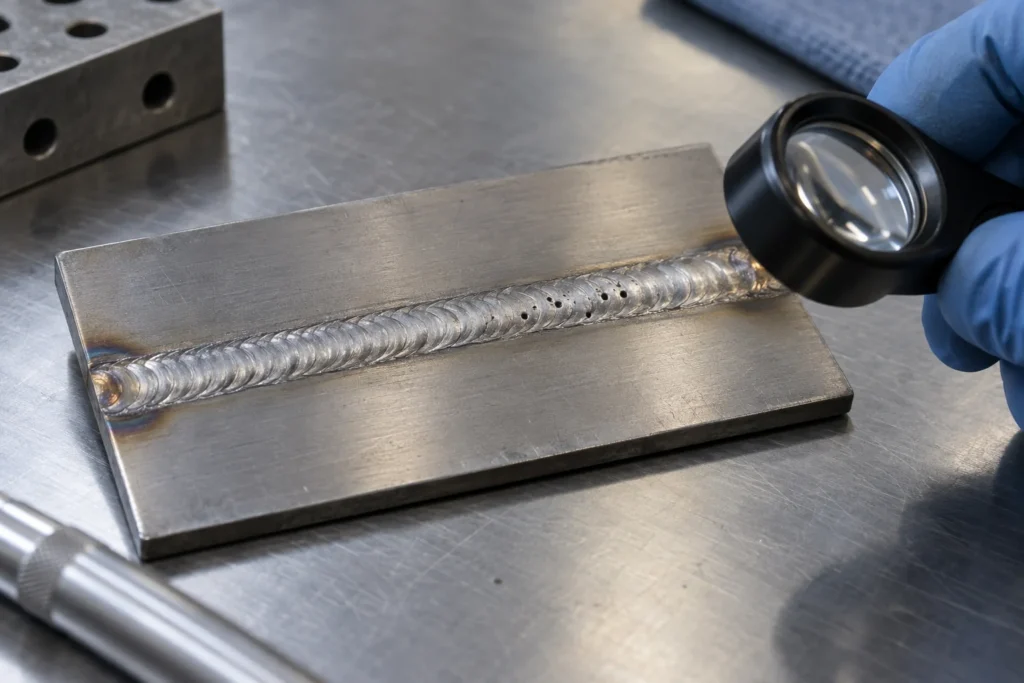
Pure argon is widely used for TIG welding carbon steel, stainless steel and aluminum. It provides a stable arc, but gas choice alone cannot prevent porosity: surface cleanliness, leaks, drafts and torch technique also matter.
Mixtures require procedure approval
Argon–helium mixtures may be considered where additional heat input is needed. Hydrogen-containing mixtures are not general-purpose substitutes and require alloy-specific procedure approval. Do not substitute a MIG shielding mixture containing carbon dioxide or oxygen without a qualified TIG procedure.
Review material-specific considerations in our guides to TIG welding aluminum, TIG welding stainless steel and TIG welding copper.
TIG Welding Gas Lens vs. Standard Collet Body
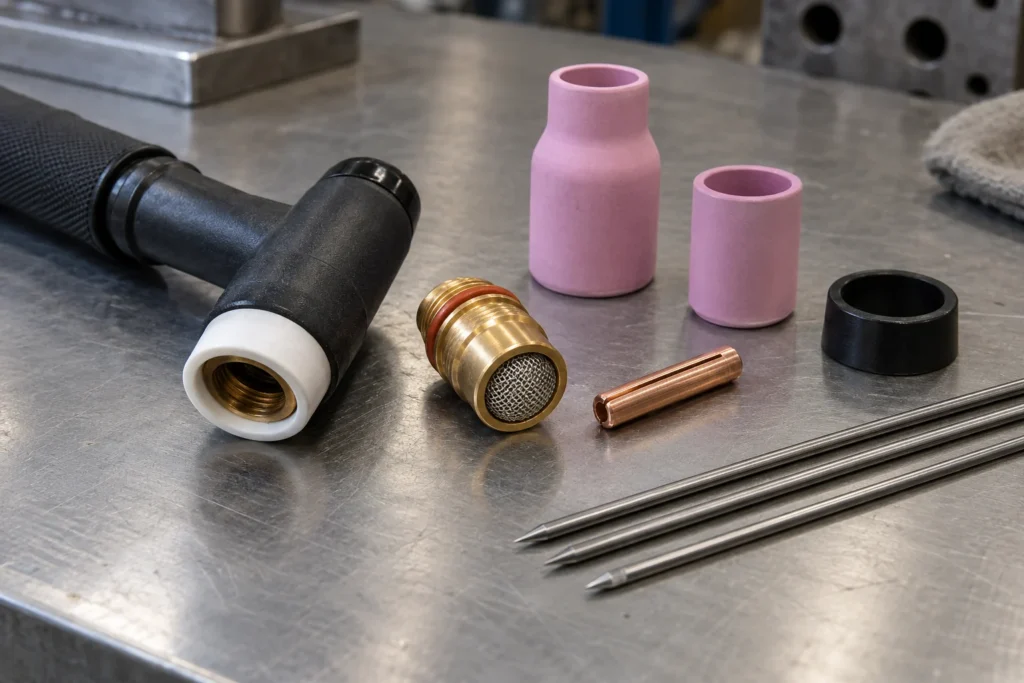
A TIG welding gas lens uses mesh screens to help distribute shielding gas more evenly than a conventional collet body. It can improve access where additional electrode extension is needed, but permitted extension and flow depend on the complete torch setup.
- Check fit: torch series, collet, electrode diameter, insulator and cup must match.
- Validate coverage: test the actual cup, electrode extension and joint; a larger lens does not guarantee freedom from contamination.
- Measure savings: compare gas used per accepted weld rather than assuming a fixed saving percentage.
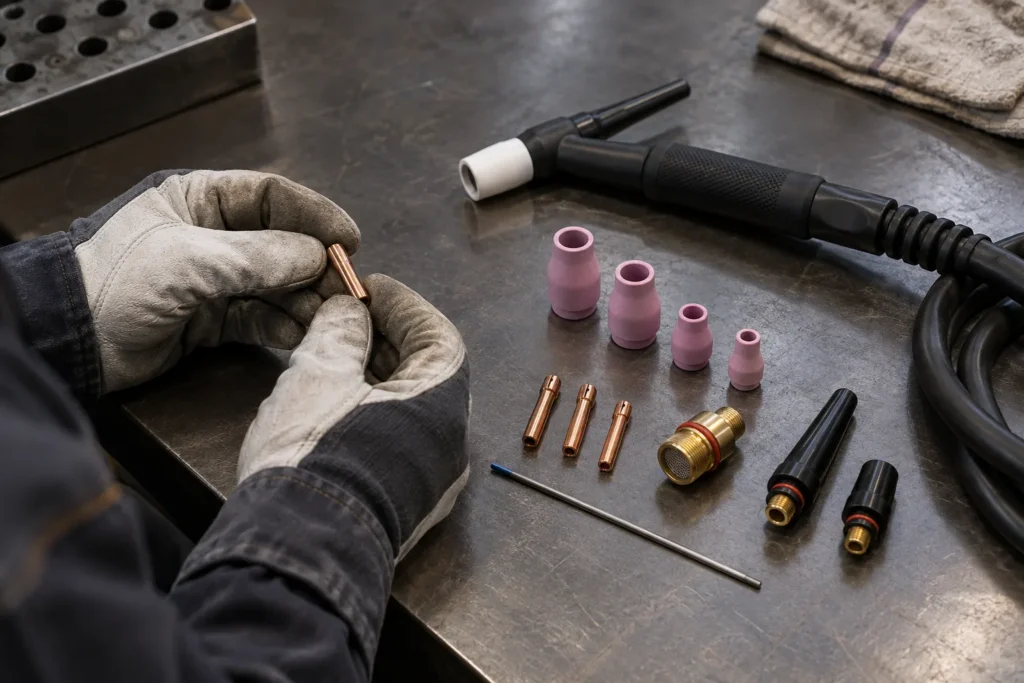
Use our gas lens fit and procurement guide and TIG torch parts guide before ordering spares.

TIG Welding Gas Flow Rate: CFH and L/min
A starting range of 15–20 CFH (7.1–9.4 L/min) is commonly suggested for many TIG setups. Manufacturer guidance varies; use the torch manual and qualified welding procedure to set the final value. More gas is not always better, because excessive flow may disturb shielding.
Gas flow unit conversion chart
| Flow (CFH) | Approx. L/min | How to use this value |
|---|---|---|
| 10 | 4.7 | Conversion only; not a universal welding setting |
| 15 | 7.1 | Common starting-range reference |
| 20 | 9.4 | Common starting-range reference |
| 25 | 11.8 | Confirm the actual torch and shielding requirement |
| 35 | 16.5 | Not an automatic cure for porosity |
Conversion basis: 1 CFH ≈ 0.472 L/min. These rounded conversions do not specify the correct flow for a particular cup or alloy.
Before increasing gas flow
- Check cylinder contents, gas-specific flowmeter calibration and hose connections.
- Measure flow with gas running; inspect leaks, cup damage and blocked screens.
- Control drafts and confirm electrode extension, arc length, preflow and postflow.
- Run a representative sample and assess it against the applicable acceptance criteria.
See Miller’s TIG troubleshooting guidance for the starting-flow context. For equipment selection, review our industrial TIG machine buying guide.
Flow rate and gas duration are separate controls. Use our TIG pre-flow and post-flow setup guide to document the start-and-stop sequence, torch-hold behaviour and sample acceptance before transferring settings into production.
Shielding Setup Comparison: What to Validate
Compare shielding hardware using evidence from the actual process, not guaranteed defect rates.
| Setup | Potential use | Required validation |
|---|---|---|
| Standard collet body | Routine access and compact assemblies | Cup size, gas distribution and allowable extension |
| Standard gas lens | More even gas distribution and restricted joint access | Torch fit, screen condition, actual flow and weld acceptance |
| Large gas lens | Wider shielding coverage where the procedure requires it | Access clearance, coverage, trailing shielding and gas consumption |
No setup guarantees zero contamination or a particular NDT pass rate. Record the gas specification, flow, electrode extension, inspection results and gas consumption for each trial.
Illustrative Shielding Validation Workflow
This is an illustrative qualification workflow, not a documented customer case or a performance guarantee. Reactive materials and high-specification joints need procedure-specific shielding and inspection requirements.
- Define the alloy, joint geometry, applicable welding procedure and acceptance criteria.
- Verify gas certification, supply cleanliness, leakage control and required torch, trailing or backing shielding.
- Document the torch setup, flow measurement, preflow and postflow used in a representative trial.
- Assess the trial using the required inspection method; qualify the process before fleet rollout.
- Measure accepted output, gas consumption and rework over a controlled production sample.

Related Products

TIG 180/200/225 DC Pulse
A compact, air-cooled TIG/Stick inverter welder designed for AC and DC welding.
- Built with durable internal components and a reinforced structure for long-term reliability.
- Supports TIG Pulse and Stick welding across stainless steel, carbon steel, copper, and other common metals.
- Compact and portable design for workshops, garages, mobile repair, and everyday fabrication work.

TIG 180/200/225P ACDC
A compact, air-cooled TIG/Stick inverter welder designed for AC and DC welding.
- Designed for aluminum welding, with precise control for thin and delicate materials.
- Advanced pulse technology helps reduce heat input and improve weld appearance.
- Built with durable components and a rugged structure for long-term reliability.
TIG 300/400/500 DC Pulse
A compact, air-cooled TIG/Stick inverter welder designed for AC and DC welding.
- Uses stronger and more durable material
- Water Cooler compatible.
- Equipped with selected and reliable accessories to enhance the welder’s experience.
- Industrial level welder with a higher redundancy design increases reliability, extends service life, and enhances durability.

TIG 315/350P ACDC
A compact, air-cooled TIG/Stick inverter welder designed for AC and DC welding.
- Water Cooler compatible.
- Uses stronger and more durable material.
- Equipped with selected and reliable accessories to enhance the welder’s experience.
- Industrial level welder with a higher redundancy design increases reliability, extends service life, and enhances durability.

TIG 400/500P ACDC
A compact, air-cooled TIG/Stick inverter welder designed for AC and DC welding.
- Water Cooler compatible.
- Uses stronger and more durable material.
- Equipped with selected and reliable accessories to enhance the welder’s experience.
- Industrial level welder with a higher redundancy design increases reliability, extends service life, and enhances durability.
Related Solutions

Pipeline
The ultimate TIG welder solution engineered for critical pipe fabrication and field pipeline construction. Driven by thoughtful R&D and built with heavy-duty solid materials, our machines deliver the precise arc control required for flawless 5G/6G root passes on stainless steel and the reliable power for deep-penetration fill passes on carbon steel pipes. Achieve X-ray quality joints and maximum uptime with a balanced design built for the world’s most demanding energy and process piping projects. GWELL ensures your crew is always ready to go with professional performance that eliminates costly field rework.

Offshore
The ultimate TIG welder solution for the most punishing maritime environments. Built with solid materials and thoughtful R&D, our machines are engineered to withstand humidity and salt spray while delivering the precise arc control required for critical offshore infrastructure. Experience professional performance in a balanced design that remains reliable on floating platforms or remote shipyards—ensuring you are always ready to go when the mission is critical.

Automotive
From thin-gauge body panels to heavy-duty chassis components, GWELL provides the precise arc control and reliable performance required for the modern automotive industry. Our Pro-tier technology ensures every joint meets the highest safety and aesthetic standards.

General Fabrication
The ultimate TIG welder solution for diverse fabrication needs. Built with solid materials and thoughtful R&D, our machines offer the precise control required for stainless steel and the reliable power for carbon steel. Experience professional performance in a balanced design engineered for the versatile fabricator.
Conclusion: Specify the Complete Shielding System
Reliable TIG welding gas performance depends on the gas, delivery system, torch consumables and welding procedure working together. Validate settings on representative parts rather than accepting universal flow values or unsupported pass-rate claims.
For a matched equipment discussion, send the alloy, thickness, joint type, torch series, cooling method and duty pattern to the GWELD equipment consultation team. Ask for model-specific documentation and trial requirements before procurement.