


TIG Welder Selection Guide for Industrial Production Fleets
9 月 3, 2026
Introduction
Selecting a 氩弧焊机 for industrial production is not simply a matter of choosing the highest amperage or the lowest quoted price. EPC contractors, fabrication plants, shipyards and pressure-vessel manufacturers need a welding system that can deliver stable arc behavior, repeatable parameters and predictable service support across many operators and shifts.
 This guide explains how procurement teams can evaluate a TIG platform for fleet deployment. It covers material capability, AC/DC and pulse control, thermal management, enclosure design, digital control, automation compatibility, spare parts and total cost of ownership. It also explains how to compare an 铝氩弧焊机, ,一 米勒氩弧焊机, ,一 gás blindado de metal arco de solda soldador, an 永恒氩弧焊机 or a 林肯氩弧焊机 with an industrial machine from a factory supplier such as GWELD.
The correct decision should be based on verified application evidence: approved procedures, representative weld samples, duty-cycle data, service access, documentation quality and the supplier’s ability to support a complete production fleet. For a first review of available industrial models, visit the GWELD TIG welder product range.
This guide explains how procurement teams can evaluate a TIG platform for fleet deployment. It covers material capability, AC/DC and pulse control, thermal management, enclosure design, digital control, automation compatibility, spare parts and total cost of ownership. It also explains how to compare an 铝氩弧焊机, ,一 米勒氩弧焊机, ,一 gás blindado de metal arco de solda soldador, an 永恒氩弧焊机 or a 林肯氩弧焊机 with an industrial machine from a factory supplier such as GWELD.
The correct decision should be based on verified application evidence: approved procedures, representative weld samples, duty-cycle data, service access, documentation quality and the supplier’s ability to support a complete production fleet. For a first review of available industrial models, visit the GWELD TIG welder product range.
This guide explains how procurement teams can evaluate a TIG platform for fleet deployment. It covers material capability, AC/DC and pulse control, thermal management, enclosure design, digital control, automation compatibility, spare parts and total cost of ownership. It also explains how to compare an 铝氩弧焊机, ,一 米勒氩弧焊机, ,一 gás blindado de metal arco de solda soldador, an 永恒氩弧焊机 or a 林肯氩弧焊机 with an industrial machine from a factory supplier such as GWELD.
The correct decision should be based on verified application evidence: approved procedures, representative weld samples, duty-cycle data, service access, documentation quality and the supplier’s ability to support a complete production fleet. For a first review of available industrial models, visit the GWELD TIG welder product range.What Is a TIG Welder?
A 氩弧焊机 uses a non-consumable tungsten electrode to establish an arc while shielding gas protects the weld pool from atmospheric contamination. Filler metal may be added manually as a rod or continuously through a cold-wire feeder. The process is valued for control, cleanliness and the ability to produce precise welds on stainless steel, aluminum, nickel alloys, titanium and other demanding materials.
In a production environment, the power source is only one part of the system. The torch, remote control, gas-delivery equipment, cooling circuit, work return, filler-metal handling and operator interface all influence the final result. A machine that looks capable on a specification sheet can still underperform if its controls are difficult to repeat, its torch interface is restrictive or its protection system is not suited to the shop environment.
Why TIG control matters in B2B production
TIG welding is often selected when appearance, penetration control, heat input or contamination risk matters. That makes process stability commercially important. A small change in current, pulse timing, gas flow or travel speed can affect rework, distortion and inspection results. For this reason, an industrial 氩弧焊机 should support parameter repeatability and clear documentation rather than relying only on operator experience. For fleet buyers, the practical question is not whether a machine can produce one good weld. The question is whether multiple machines can produce the same acceptable weld over long production cycles, with different operators, in different work cells and under the same documented procedure.Manual rod, cold wire and automated TIG
Manual filler rod is flexible for repair, prototypes and short joints. A cold-wire feeder can improve rhythm and consistency on long seams or repeated assemblies by delivering filler at a controlled rate. Automated or digitally managed cells may also require remote control, procedure recall, fault feedback and communication with a production network. These needs should be identified before the welding power source is standardized across a plant. Before choosing manual rod or continuous feeding, review our TIG welding wire and feeder compatibility guide for alloy selection, wire diameter, storage and feed-system checks. Match the consumable and delivery method to the qualified procedure and validate the complete setup on representative parts. Standardize electrode preparation alongside the power source. See our TIG welding tungsten selection and color chart for electrode identification, AC/DC application checks and repeatable tip preparation.How to Match a TIG Welder to Industrial Applications
The best 氩弧焊机 depends on the base metal, thickness range, joint design, production volume and inspection requirements. A procurement team should convert these variables into measurable specifications before requesting quotations. This prevents a product comparison from becoming a simple contest between maximum amperage numbers.
Start with the approved welding procedure
Collect the applicable WPS, PQR, project standard and customer acceptance criteria. Record the material grade, thickness, joint position, preheat or interpass requirements, shielding gas, tungsten type, filler classification, travel speed and expected deposition pattern. Where a new machine is being introduced, perform a representative procedure qualification or production trial instead of assuming that an existing parameter set will transfer without adjustment.Separate peak output from usable output
Peak amperage is useful, but it does not describe how a machine behaves during a complete shift. Ask for output information at the current and ambient temperatures relevant to the factory. A credible industrial supplier should be able to discuss 40°C chamber testing, duty-cycle evidence, overload behavior and cooling performance. If a model is expected to operate continuously, verify the actual current range at the required duty cycle rather than using a short-duration maximum as the primary selection criterion.Match the machine to the work cell
Check available input power, phase configuration, generator compatibility, cable length, torch type, remote-control options and cooling requirements. A compact air-cooled machine may be appropriate for mobile fabrication, while a water-cooled platform may be preferable for long high-current seams. The right choice is the one that fits the work cell without introducing avoidable adapters, cable losses, heat accumulation or operator delays. For multi-site procurement, create a common specification sheet and record approved options separately. This makes it easier to compare the same 氩弧焊机 configuration across plants and reduces variation in training, spare parts and procedure management.AC/DC, Pulse and Material Capability
Material capability is one of the clearest ways to distinguish an industrial 氩弧焊机 from a general-purpose power source. DC TIG is commonly used for stainless steel, carbon steel, copper and nickel alloys. AC TIG is required for aluminum and many aluminum-alloy applications because the alternating waveform helps manage oxide-film removal while maintaining control of the weld pool.
When an aluminum TIG welder is required
An 铝氩弧焊机 should provide stable AC operation, adjustable balance and frequency, reliable arc starting and controls that can be repeated between machines. Aluminum transfers heat quickly, develops a persistent oxide layer and can change from cold to overheated with little warning. Operators therefore need a predictable arc and a clear way to save or recall qualified parameters. Review the required alloy families, thickness range and joint types. Thin sheet, structural aluminum, heat exchangers and large fabricated frames may require different torch, cooling and waveform choices. Do not approve a machine solely because it has an AC label; request sample welds using the actual alloy, thickness and filler combination.Pulse control and heat input
Pulse TIG alternates between peak and background current to help manage heat input, arc concentration and weld-pool timing. It can be valuable for thin sections, position welding and applications where distortion or visible bead appearance is tightly controlled. However, pulse settings must be connected to a documented procedure. More adjustment does not automatically mean better production. The controls should make the qualified setting easy to reproduce and difficult to change accidentally. For industrial evaluation, ask the supplier to show how pulse frequency, peak current, background current, upslope, downslope and post-flow are set and stored. A 32-bit DSP control platform can support high-speed digital waveform management, but the procurement team should verify the practical result through repeatability tests, parameter records and production samples.Gas, tungsten and filler compatibility
Arc performance is also influenced by the gas lens, torch cup, tungsten preparation, shielding-gas purity and filler-metal handling. Include these items in the trial plan. If a cold-wire feeder will be used, test wire diameter, liner, feed-roll and start/stop synchronization with the selected power source. This is especially important when comparing a standalone 氩弧焊机 with a broader welding cell.Electrical, Thermal and Enclosure Requirements
Industrial welding electronics operate in environments containing dust, metal particles, humidity, vibration and heat. A machine that performs well in a clean demonstration room may need a different maintenance plan on a busy production floor. Enclosure design, airflow, component protection and service access should therefore be part of the technical comparison.
Input power and electrical stability
Confirm input-voltage range, phase requirements, power factor, generator behavior and protection against abnormal supply conditions. Where plants operate across regions, document the exact electrical configuration for each destination rather than assuming that one nameplate covers every market. The same check should include plug standards, cable assemblies and any required local compliance documentation.Thermal management and duty cycle
Ask how the cooling path separates heat-generating components from dust and how the fan and heat sink are protected from contamination. An isolated wind-tunnel enclosure can help keep the power section and control section more stable, while an IP23 or IP24 protection approach may be relevant to the planned installation environment. These ratings and design claims must be verified against the supplier’s technical documents and the actual model under consideration. Useful evidence includes thermal test conditions, overload protection behavior, fan control logic, operating-temperature range and service intervals. If the fleet will run across multiple shifts, request data for 100% duty-cycle operation at 40°C where available. If that evidence is not available, treat the gap as a procurement risk and plan a longer production trial.Service access and component transparency
Downtime is affected by more than component failure. Difficult panel removal, unclear wiring diagrams and unavailable replacement parts can extend a repair from hours to days. Ask for service manuals, spare-part lists, firmware or parameter backup procedures, warranty scope and repair turnaround time. An Open-BOM approach can make the supply chain easier to audit when the supplier can identify major components, approved alternates and traceability records without exposing confidential design details.Controls, Automation and Fleet Standardization
Many industrial buyers now expect a 氩弧焊机 to fit into a wider production-information system. Even when welding remains operator-controlled, the machine may need to exchange data with quality systems, factory networks or a central parameter-management process.

Make operator variance visible
Look for a control interface that presents the important parameters clearly and prevents accidental changes. Useful functions may include password-protected settings, procedure recall, remote or foot-pedal input, fault codes, parameter backup and a consistent menu structure across the product family. These functions reduce the training burden when operators move between cells and make it easier for supervisors to investigate a nonconforming weld.Check communication architecture early
For automated or digitally managed production, ask whether communication is native, gateway-based or unavailable. The required interface may include Profinet, EtherCAT, Modbus TCP, digital I/O, remote parameter selection, fault-status feedback or welding-data monitoring. The exact protocol is less important than confirming the data points, update behavior, electrical interface and responsibility for integration. Request a wiring diagram and an integration test plan before the purchase order. A machine can be advertised as automation-ready while still requiring an unplanned gateway, custom cable or third-party controller. Identifying these dependencies early protects the schedule and keeps the total cost visible.Standardize the fleet without blocking applications
Fleet standardization should cover the common machine family, torch connections, consumables, parameter naming, spare parts and service procedures. It does not mean forcing every application into one current range. A practical standard may include one compact model for general fabrication, one higher-output AC/DC model for heavy aluminum work and one water-cooled configuration for long high-current seams.How to Compare TIG Welder Brands and Models
Search results often place terms such as 米勒氩弧焊机, 永恒氩弧焊机 和 林肯氩弧焊机 next to generic industrial options. These terms can help a buyer understand market expectations, but a B2B decision should compare documented performance and support conditions rather than brand familiarity alone.
Use a neutral comparison matrix
Build a matrix that includes AC/DC capability, pulse range, current stability, duty-cycle evidence, input-power requirements, enclosure and cooling design, interface options, documentation, warranty, spare-part availability and service response. Add the cost of torches, water coolers, remote controls, feeders, cables and commissioning. This prevents a lower machine price from hiding a higher installed cost.Do not confuse process categories
A gás blindado de metal arco de solda soldador may describe a combination machine or a buyer’s comparison between MIG and TIG processes. The correct choice depends on productivity, material, joint access, appearance, deposition needs and procedure requirements. Combination capability is valuable only when the plant will use it and when the interface does not compromise the TIG controls required by the critical applications.Test before fleet approval
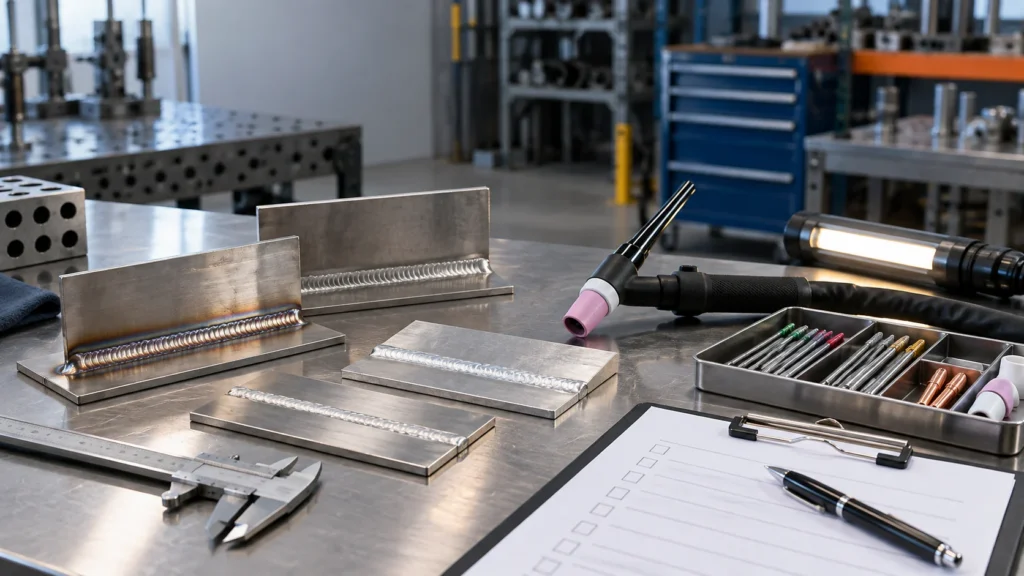
Ask each shortlisted supplier to weld the same representative parts using the same torch, gas and filler specification. Measure arc starts, bead consistency, visual acceptance, distortion, operator setup time and recovery after a fault. For a fleet decision, repeat the test on more than one unit and involve the welding engineer, maintenance team and production supervisor. GWELD buyers can review the industrial TIG welding machine portfolio and discuss a configuration based on material, output, work-cell layout and regional support requirements. The purpose of the comparison is to identify the machine that delivers repeatable production value, not to create a list of specifications that cannot be verified on the shop floor.Total Cost of Ownership and Procurement Checklist
The purchase price of a 氩弧焊机 is only one part of the business case. Total cost of ownership should include energy use, consumables, rework, downtime, training, maintenance, spare parts, freight, commissioning and the cost of keeping multiple machine variants in inventory.
For application-specific recommendations, connect the machine specification to the production target and send the required material, thickness, duty pattern and work-cell information through the GWELD technical inquiry team.
Calculate cost per accepted weld
Where production data is available, compare suppliers using cost per accepted weld or cost per production hour. Include wire or rod consumption, failed starts, cleaning time, inspection, repair and the expected service life of torches and cooling components. This approach is more meaningful than comparing only cost per unit or cost per kilogram of equipment.Ask for a complete supply and support package
- Confirm model configuration, input power, output range and accessories.
- Request duty-cycle, thermal, enclosure and overload documentation.
- Define procedure transfer, parameter backup and commissioning support.
- Check replacement-part availability, warranty scope and repair turnaround time.
- Confirm training materials, service contacts and escalation procedures.
- Record packaging, storage, lot traceability and material certificates where applicable.
- Evaluate MOQ, lead time, recurring supply planning and fleet-level pricing.
Industrial TIG welder procurement checklist
| Evaluation area | Questions to document | Evidence to request |
|---|---|---|
| Application fit | Which materials, thicknesses, positions and joint types are approved? | Representative weld samples and procedure records |
| Output and thermal behavior | What current is available at the required duty cycle and ambient temperature? | Test conditions, duty-cycle data and overload behavior |
| Control and repeatability | Can qualified parameters be stored, recalled and protected? | Interface demonstration and parameter backup procedure |
| Integration | Which signals and industrial protocols are supported? | Wiring diagram, data map and integration test plan |
| Lifecycle support | How quickly can common parts be supplied and repairs completed? | Spare-parts list, warranty and service SLA |
Related Products
Review GWELD TIG welder models for different industrial output ranges, material requirements and production-cell configurations.

TIG 400/500P ACDC
A compact, air-cooled TIG/Stick inverter welder designed for AC and DC welding.
- 适用于饮水机.
- 采用更坚固耐用的材料。.
- 配备精选且可靠的附件,以提升焊工的体验。.
- 工业级焊机采用更高的冗余设计,可提高可靠性、延长使用寿命并增强耐用性。.

TIG 315/350P ACDC
A compact, air-cooled TIG/Stick inverter welder designed for AC and DC welding.
- 适用于饮水机.
- 采用更坚固耐用的材料。.
- 配备精选且可靠的附件,以提升焊工的体验。.
- 工业级焊机采用更高的冗余设计,可提高可靠性、延长使用寿命并增强耐用性。.

TIG 180/200/225P ACDC
A compact, air-cooled TIG/Stick inverter welder designed for AC and DC welding.
- 专为铝焊设计,精确控制细薄易损材料。.
- 先进的脉冲技术有助于减少热输入并改善焊缝外观。.
- 采用耐用组件和坚固结构,确保长期可靠性。.
Ask GWELD to confirm the best model, accessories, duty-cycle evidence and commissioning package for your application.
相关解决方案
Explore GWELD solutions that support repeatable TIG welding in different industrial production environments.


重型制造
重工业严苛需求的终极TIG焊机解决方案。我们的设备采用坚固的材料和周到的研发,可提供高强度不锈钢接头所需的精确控制,以及厚碳钢深层熔透所需的可靠动力。体验专业性能,平衡设计,专为最苛刻的制造环境而打造。.

Discuss the material, joint, output, automation and service requirements with GWELD before standardizing your fleet.
Frequently Asked Questions
What should I look for first when buying a TIG welder?
Start with the approved welding procedure and production environment. Confirm material, thickness, AC/DC need, duty pattern, input power, torch and cooling requirements before comparing price or maximum amperage.Do I need an aluminum TIG welder for every aluminum application?
Most aluminum applications require dependable AC TIG control, but the correct waveform, balance, frequency, torch and cooling configuration depend on alloy, thickness and joint design. Validate the complete setup with representative welds.Is a MIG TIG welder suitable for an industrial fleet?
A combination machine can be useful when the plant regularly uses both processes. Check whether the TIG interface, parameter repeatability, output range and service plan meet the critical TIG procedures instead of assuming that combined capability is automatically better.How can I compare a Miller TIG welder, Everlast TIG welder or Lincoln TIG welder with another supplier?
Use the same application test and comparison matrix for every supplier. Evaluate qualified weld results, thermal evidence, controls, serviceability, documentation and total cost of ownership rather than relying on brand recognition or a single specification.What documents should an industrial TIG welder supplier provide?
Request the datasheet, duty-cycle and thermal information, input-power details, wiring diagram, operation and service manuals, spare-parts list, warranty terms, parameter-backup process and commissioning plan. Add compliance documents required for the destination market.Conclusion
The right 氩弧焊机 for industrial production is the one that matches the approved procedure, remains stable through the planned duty pattern and can be supported across the life of the fleet. AC/DC and pulse control, thermal management, enclosure design, digital waveform control, automation interfaces and serviceability should be evaluated together.
A disciplined procurement process makes the result measurable: define the application, run representative tests, compare complete installed cost, standardize the support package and document the final configuration. GWELD supports industrial buyers with TIG welding machines, application discussions and factory-level technical coordination. Request a project-specific TIG welder recommendation from GWELD.
Related Blogs

TIG Welder Machine for Sale: Industrial Fleet Buying Guide
8 月 30, 2026

TIG Welding Stainless Steel: Pipe, Pulse & Purging Guide
8 月 21, 2026

TIG Welding Wire: How to Choose Aluminum and Stainless Steel Filler Wire
9 月 1, 2026

工业TIG焊接铝材:车队优化白皮书
2026年7月2日
Cheap TIG Welder: Industrial Cost and Buying Guide
9 月 12, 2026